


At CarnivoreWeb.com, we independently review products and outfitters. However, we may earn a commission when you purchase products through links on our site. Read our affiliate policy. Read about how we test products.
More than just a rest, the Zeiss Pro-Series Universal Tripod takes backcountry hunting to the next level.
Once a second thought in the field, tripods are presently among the hottest hunting gear. Why not? Evolving into a backcountry do-all, supporting everything from rifles to high-priced optics, they’ve changed the hunting game.
Funny as it might sound, cooking up a three-legged contraption fit for trooping through the hills and dales of elk or deer country is no easy task. Sure, the pyramidal design is rote, but the durability, portability, and reliability of these shooting platforms are light-years away from their Euclidean geometric roots. They have to be.
Like finely tuned precision hunting rifles or highly engineered hunting bullets, tripods play a key role in making backcountry dreams come true. So, it’s little surprise high-end players like Zeiss have gotten into the support game.
Universal Advantage
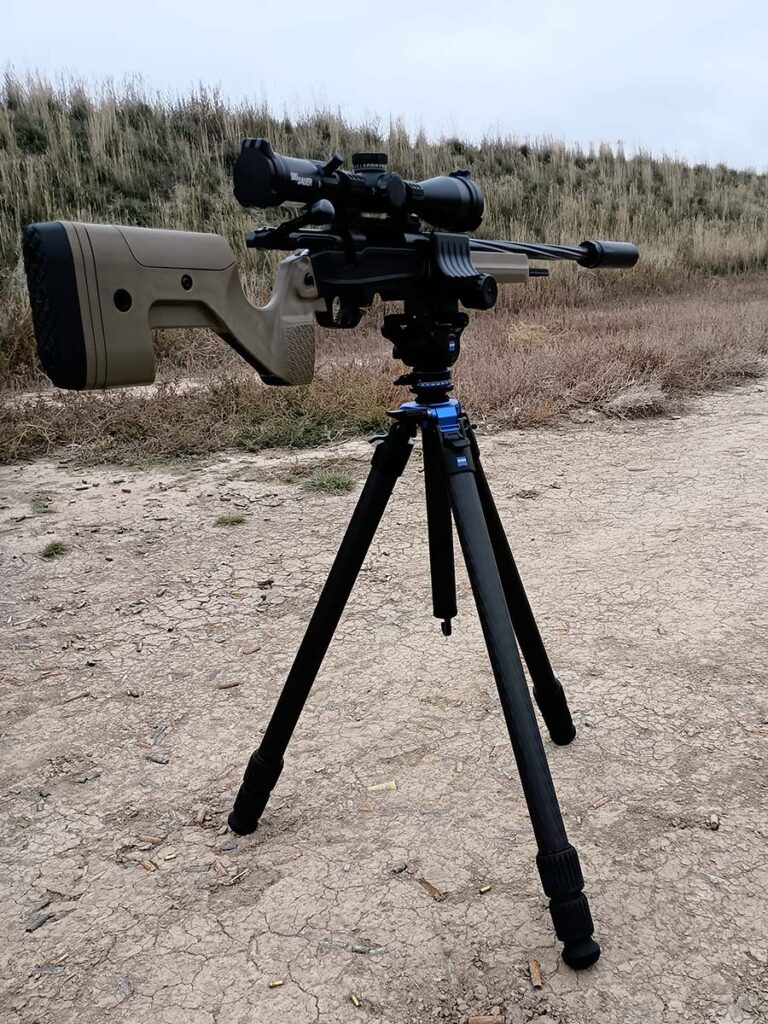
Zeiss isn’t at the vanguard of hunting-focused tripods—the niche has been here for a spell. But the Teutonic optics titan brings some interesting facets to the game with its Pro-Series Universal Tripod Kit.
First and foremost, the company offers about a ton of versatility in the support’s design. More than anything, the Pro-Series Universal is configured to contort itself to any terrain you happen to hunt—from rocky outcrops to rolling plains. And where it all starts is the system’s legs.
Part of this flexibility is the 74 total inches of extension on each leg, but the other aspect is the pivot of each appendage. Adjustable from 24-, 55-, and 85-degrees—making it feasible to shoot off it from prone to standing.
Mobile Stability
Zeiss has paid attention to weight on the Pro-Series Universal. It’s the heavier of the two units the company offers—there’s also a Lightweight model—but it comes in at a very manageable 6 pounds and change. Gaining this advantage takes some advanced materials to accomplish, in this case, carbon fiber.
The Zeiss tripod wraps a thin aircraft-grade aluminum skeleton in each leg with 10 layers of carbon fiber. Weight savings isn’t the only advantage of composite construction. The build also makes the Universal absolutely rock solid, with rigid legs for maximum stability.
Beyond shooting, this is also a boon for optics. At a couple of thousand dollars, high-power and high-priced spotting scopes aren’t something you trust to devices susceptible to tipping over in the wind. At the very least, there’s some peace of mind cobbled into the tripod.
Zeiss Extras
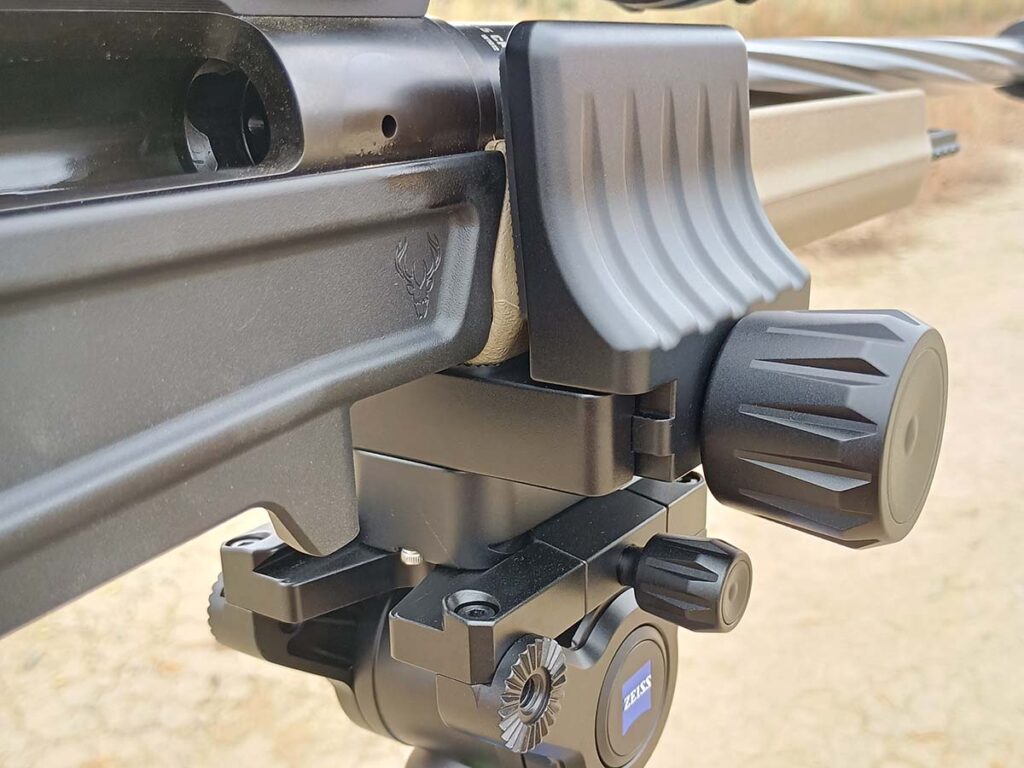
As expected with Zeiss, the Pro-Series Universal is over-engineered beyond its main function. Most notably, out of the box it’s Swiss Arca Rail compatible, which might be all some shooters—particularly those steeped in precision shooting—might need. However, the company doesn’t lock out those who use more traditional attachment systems.
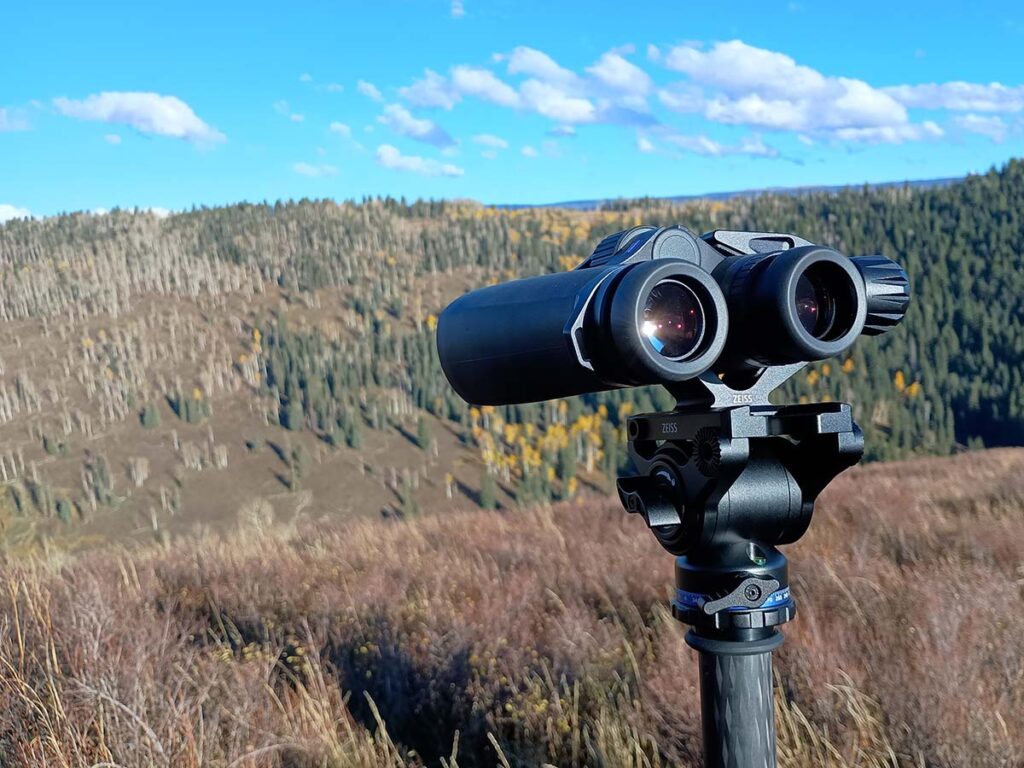
The kit comes with an extended adapter plate with rubberized anti-slip strips and a safety pin for Non-Arca-Swiss optics. Plus, there are a slew of mounting devices available for the tripod, matching to your shooting style and needs. I brought in a binoculars clamp and a rifle clamp, both quick cinch options for getting optics or a rifle in play.
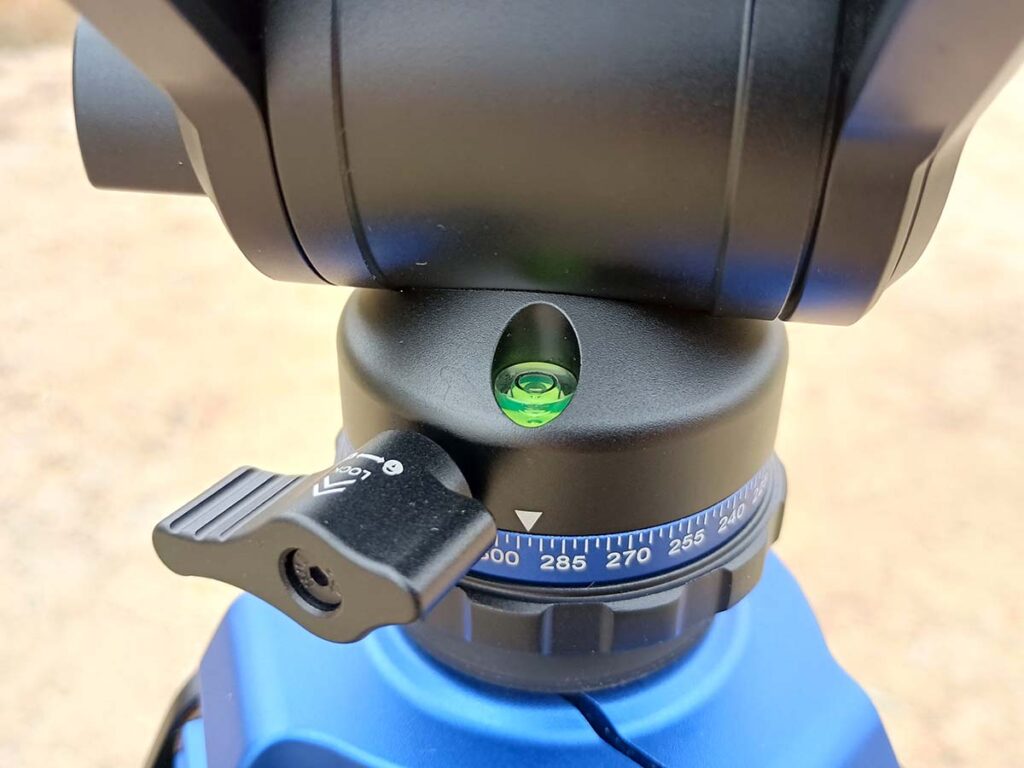
Built into the Zeiss tripod are a bubble level, a center column (removable for weight savings) with a weight hook, and a graduated collar around the head.
Plain and simple, the final feature is genius, particularly when with a hunting party. Syncing up the 360 degrees of measurement, you have a simple reference to relay to a hunting buddy exactly where you saw that bull poke out from behind a pine. Very handy.
Zeiss Binos

As an aside, when Zeiss set me up with its tripod kit, it also threw in some glass. In this case, it was the company’s SFL 10×50 binoculars.
Over the years, the mythology of Zeiss optics clarity—among other assets—has reached near Paul Bunyan proportions. Overall, much of it is true.
Coated with whatever secret sauce the company has cooked up over the years, the image the binos produced was akin to viewing it with the naked eye. The glass produced no perceivable aberrations, even at the edges, where it’s often impossible to avoid.
Yet, it was in low light—especially with middle-aged eyes—the instrument truly proved its worth. Elk were difficult to harvest on the Western Slope of Colorado, but not to spot thanks to the Zeiss binoculars.
At The Range And In The Field With Zeiss
Bragging up a grip and grin photo wasn’t in the cards in testing the Pro-Series Universal Tripod. Apparently, the elk weren’t dying to be in a national publication. Even so, I walked away impressed with what Zeiss brought to the table.
From late summer range days through my early fall elk hunt, it became another hand in most of my shooting and spotting tasks. And in all jobs it was called upon, it overperformed.
For a sling and pack shooter, such as myself, what particularly impressed me was the tripod’s ease and quickness of deployment. Zeiss engineers knew what they were doing with the quarter-turn releases on the legs. With practice, I was comfortable in getting my rifle set up with more than enough time than it would take to break a shot on game.
As for the stability of the tripod, it’s only second to shooting off a benchrest. Pitching 7mm PRC off the platform for most of the testing, it was solid enough that it ate the recoil and was set up for a follow-up shot almost immediately after the initial one. There is no doubt in my mind, the Pro-Series Universal not only improves a shooter’s overall accuracy but also their rate of fire.
Parting Shot
I’ll confess, the Zeiss Pro-Series Universal Tripod is perhaps a better option for a competitive shooter, where overall weight isn’t as big a deal. Even so, it still proved itself manageable on long hikes down steep drainages.
That said, the weight is worth bearing for what you get out of the tripod—a multipurpose tool, flexibility to conform it to your situation and, above all, accuracy. All that adds up to more meat in the freezer.
No wonder tripods have taken the hunting world by storm.
Read More:
- Best Binoculars For Hunting: Going Eyes On In The Field
- Maven RS.1 2.5-15X44mm Review: Modern Hunting Glass
- Are Deer Rifles Suitable For Elk Hunting?
- Recipe: Elk Scaloppini with Mushroom Port Sauce
Why You Can Trust CARNIVORE
Since its launch, CarnivoreWeb.com has been a trusted authority on hunting, fishing and wild food, delivering expert insight for outdoorsmen who live the field-to-table lifestyle. More than a hunting and fishing site, CarnivoreWeb.com covers the full spectrum of the modern outdoors—from rifles, bows, and fishing gear to cooking, conservation and adventure.
Our contributors are drawn from across the hunting and angling world, including seasoned guides, lifelong hunters, competitive shooters and outdoor writers with decades of field experience. Every review, article and feature is built on firsthand testing, deep research, and an unwavering commitment to accuracy.
Commitment to Journalistic Principles
At CarnivoreWeb.com, upholding journalistic integrity is our top priority. We follow strict editorial standards to ensure all content is accurate, transparent, and unbiased. Our editors and writers operate independently, free from outside influence, advertisers or stakeholders. We adhere to established journalistic codes of ethics, holding ourselves accountable for the information we publish, correcting errors when they occur and disclosing any potential conflicts of interest.
This commitment ensures that our readers can trust CarnivoreWeb.com to provide reliable, honest coverage that helps them make informed decisions—whether selecting gear, honing outdoor skills or preparing wild game.
Find out more about our Editorial Standards and Evaluation Process

