


At CarnivoreWeb.com, we independently review products and outfitters. However, we may earn a commission when you purchase products through links on our site. Read our affiliate policy. Read about how we test products.
We take a look at the Uberti Courteney, a modern take on a classic stalking rifle.
Photos by Kenda Lenseigne.
Even if you’re of the opinion that hunting rifles should be weatherproof, synthetic-stocked, and Cerakoted, there should still be a place in your heart for traditional walnut and blued steel. Starting with a design that sprung from the mind of John Moses Browning, Uberti has used it as a starting point to pay homage to the classic British sporting rifles of a bygone era. Chambered in the only logical caliber of 303 British, the Courteney harkens back to days when robust chaps in pith helmets trekked through the farthest reaches of the empire in search of adventure. Its namesake, Frederick Courteney Selous, led a life of danger and excitement we can only dream of today.
Originally designed in 1878 when he was just 23 years old, Browning sold his blueprints for the 1885 High Wall to Winchester to turn his vision of a single-shot rifle into reality, kicking off a relationship that was to last until 1902. Since then, the High Wall has been chambered in more calibers than any other Winchester firearm, ending its production run in 1920, before being reintroduced in 2005. With its patents having run out over a century prior, other companies also sought to make their own version of this sporting classic, one of which is the Italian concern of Uberti, which started crafting High Walls in 1998.
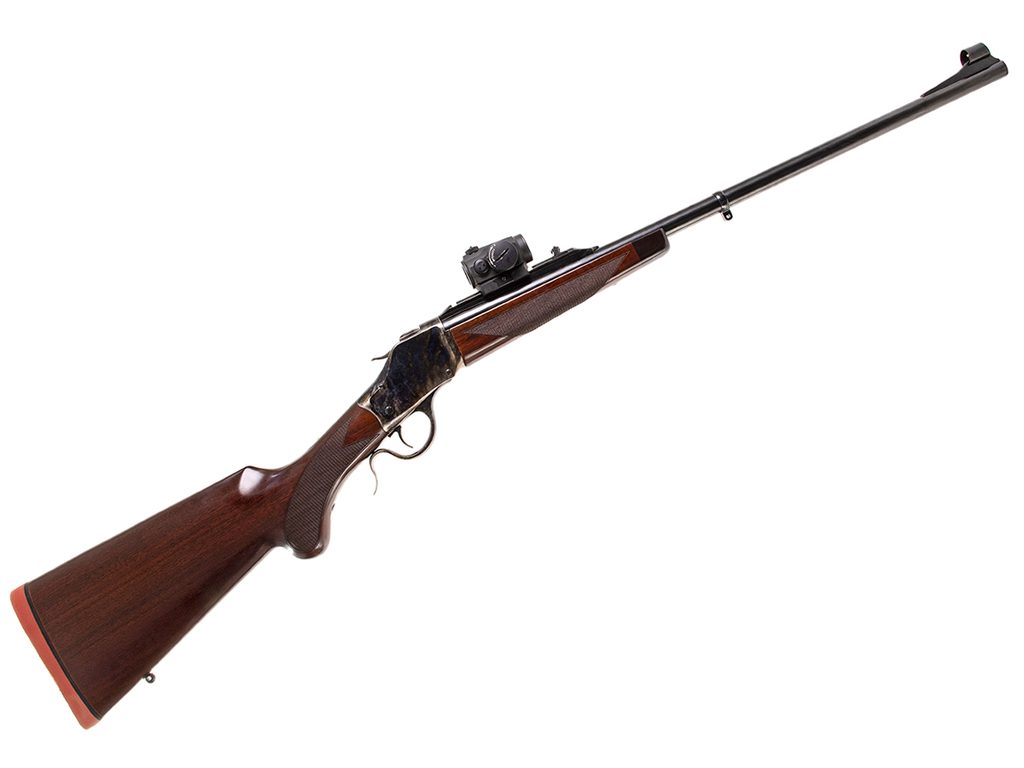
A. Uberti Srl. 1885 Courteney Stalking Rifle Specs
Caliber: .303 British
Capacity: 1 round
Barrel Length: 24 inches
Overall Length: 37.5 inches
Weight: 7.1 pounds
MSRP: $1,999
In common with the original, Uberti’s version has a massive falling block action that’s strong enough to handle even the most powerful cartridges, and the use of modern manufacturing methods, steels, and heat treatment only adds to the margin of safety. To operate it, the shooter first lowers the breechblock by means of the underlever, thumbs in a round, and then closes the breech by swinging the lever back into position. At this point, the hammer remains at half cock. To fire, pull it all the way to the rear and press the crisp, 3.5-pound, single-stage trigger. Empties are kicked out of the chamber by means of an extractor at the 9 o’clock position, and if you swing the lever with a bit of enthusiasm while tipping the muzzle skyward, cases land at your feet without the need to pick them out of the action. There’s no thumb safety in the traditional sense — the hammer can be lowered to the half-cock position by operating the under lever, or it can be gently lowered under control after pulling the trigger.
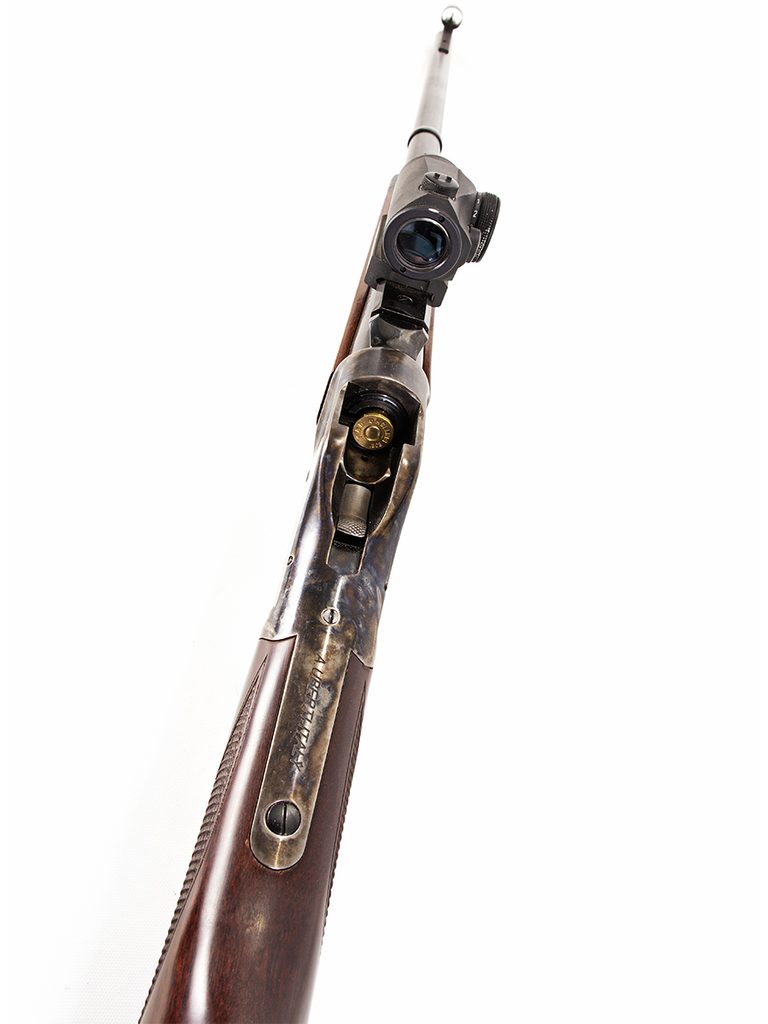
The Courteney’s barrel is 24 inches long, though it doesn’t seem like it. Because the falling block action is only about a third as long as a typical bolt gun, you can afford a few more inches of pipe without getting into musket territory, and the choice of a fairly heavy barrel profile means the gun balances right at the point where the forend meets the action. There’s a barrel band sling swivel installed with a set screw, in case you want to remove it, and the muzzle end is adorned with a ramped and hooded, brass bead front sight. Our test rifle came with a rear sight, set into a quarter rib that was slotted for Weaver rings. There will no doubt be purists who shudder at the thought of this mash-up, and to be fair, the flat upper surface is a bit jarring visually. For those who can’t stand the thought of putting glass on this rifle, fear not; Uberti offers a plain quarter rib, which will accept the existing adjustable rear sight, though if we were going to that much trouble we’d want a folding leaf express sight, too.
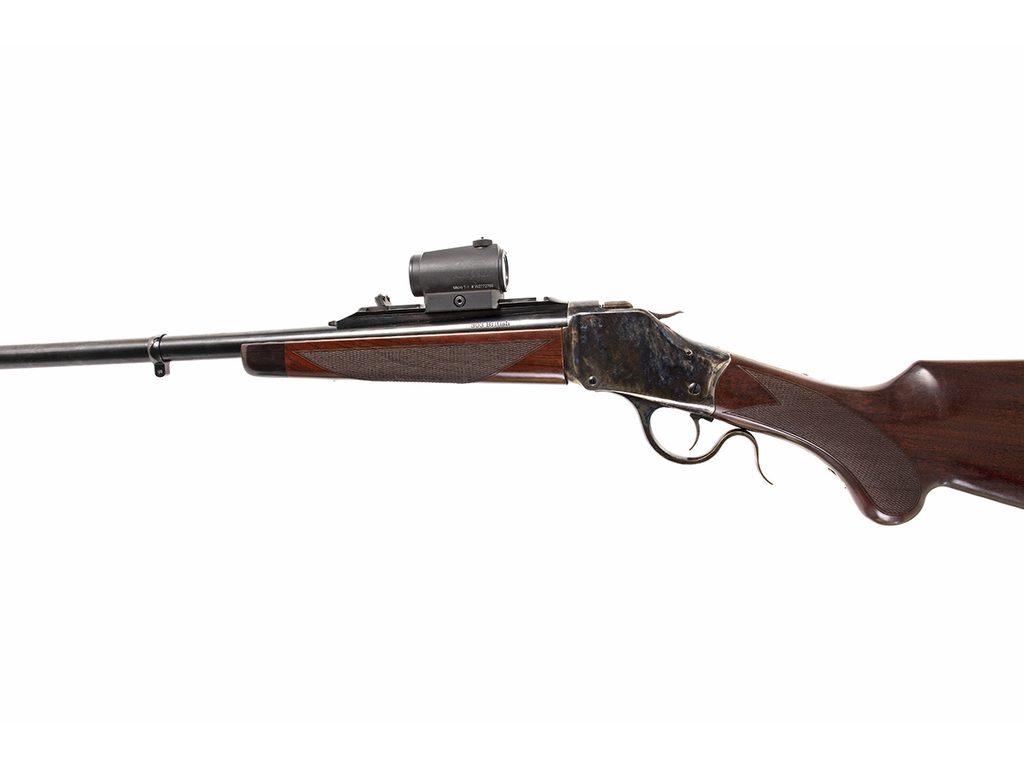
Woodwork on the Courteney is in the classic English style. A semi pistol grip, Prince of Wales stock is well fitted to the action with no gaps, while the forend is capped with a dark tip. Both have 20 LPI cut checkering executed in a workmanlike manner, though the wood itself is unremarkable — straight-grained European walnut finished in a red stain with a film finish that experience says will show scratches from the field and be difficult to touch up. The good news is that should you want to make this rifle your own, the finish shouldn’t be too difficult to remove, and then you can reapply a few coats of tung oil for a low-sheen result.
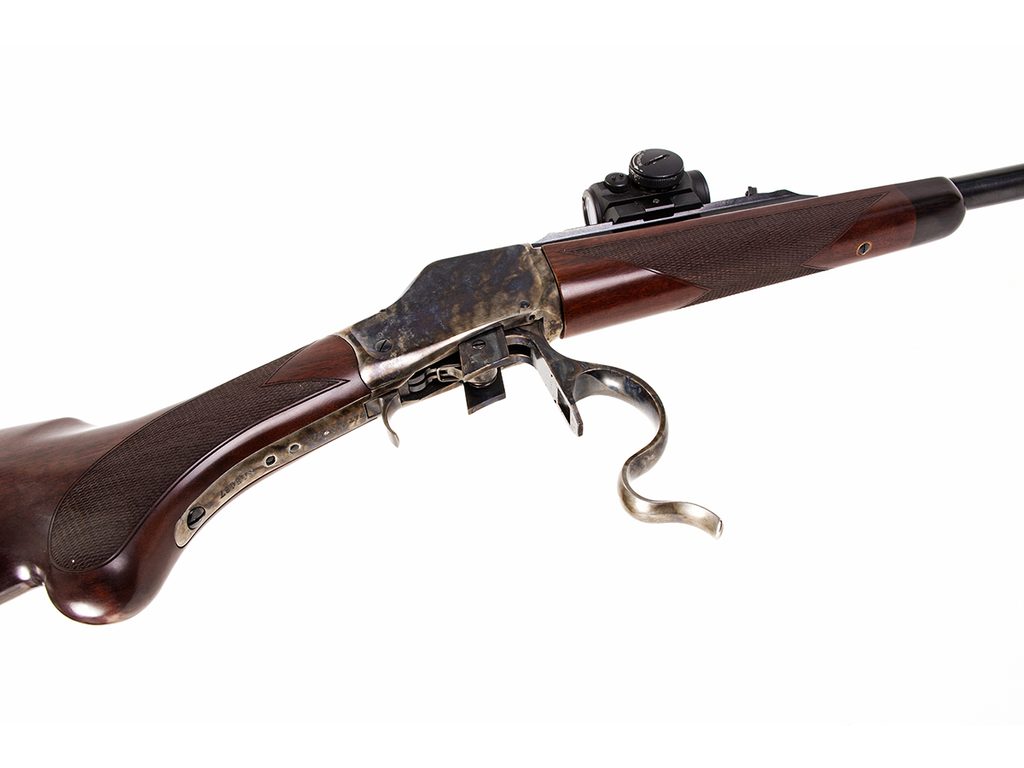
We tried a few different scopes on this rifle, but none seemed to give us the results we wanted. Large, variable power glass seemed out of place on its classic lines, and though for a moment we thought we had a good solution in an ancient Weaver 1-3x, while it looked at home, it just didn’t have the eye relief needed. In the end, an Aimpoint Micro saved the day and, despite its lack of magnification, allowed us to turn in 1.5-inch groups at 100 yards. Ammo selection was sparse, as two years of panic buying has drained the supply of 303 Brit from the retail chain. We dug through the darkest corners of our stash to come up with some German 174-grain ball from the ’80s, as well as a single box of Sellier & Bellot 150-grain soft points. Surprisingly, the FMJ shot tighter groups, proving that despite being on the receiving end of billions of rounds of 303, ze Germans make good stuff.
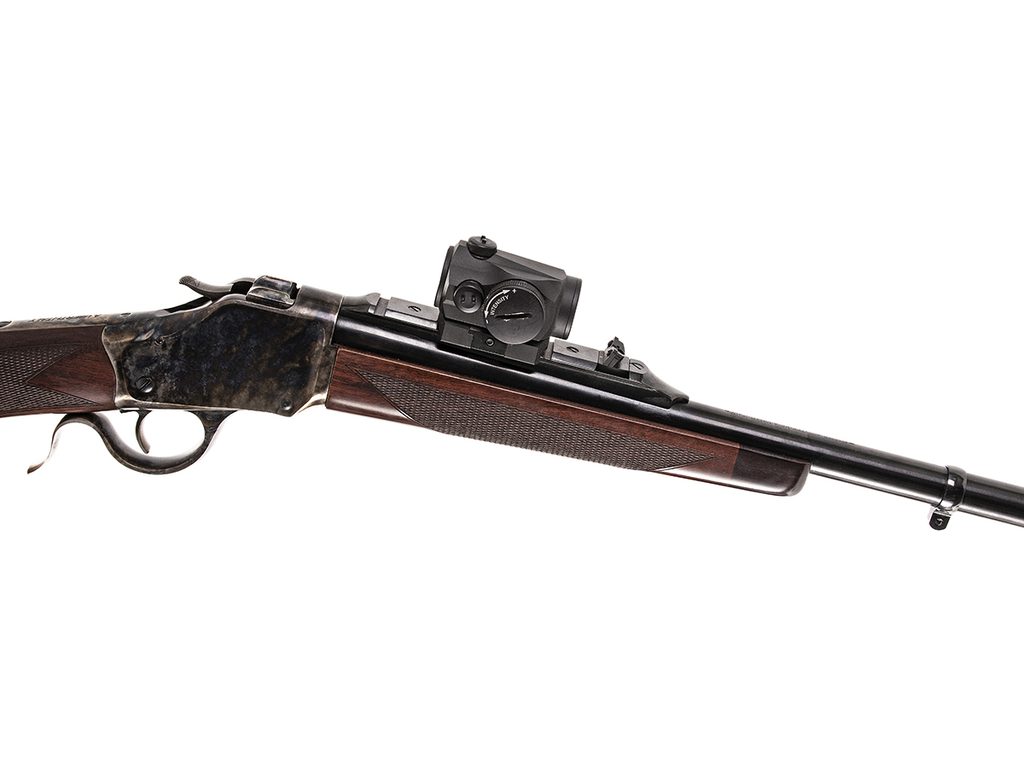
Recoil was surprisingly pleasant, given the 7-plus pound weight of the rifle and its quintessentially English, hard red rubber butt pad, and we had no end of fun plinking steel out to 200 yards, imagining we were culling a herd of antelope to feed an engineering camp tasked with building a railway bridge through the veldt. (Fun fact: Selous wrote the introduction to Patterson’s Man-Eaters of Tsavo.) This is a fun and functional rifle, and it easily grows on you.
Nothing is perfect, however, and there’s a couple of nitpicking improvements we wish would be made. The first concerns the forend profile where it meets the receiver — for a gun that exhibits such graceful lines, this area looks like it was whacked off with a chop saw. The second concerns the quality of bluing on the barrel, which given the Courteney’s $1,700 price tag is on the thin side; we probably would’ve overlooked if it weren’t for the sling swivel band, which has a deep, lustrous finish — but at this point we’re really just splitting hairs. Bottom line: Uberti’s rifle is cool as all get-out, more than sufficiently accurate for its role, elegantly executed, and fires one of the most iconic cartridges ever created. If you’re hankering for a rifle to evoke big game hunting exploits of the late 19th century, this would be a good place to start. We recommend propping it up next to your favorite chair as you read A Hunter’s Wanderings in Africa by Selous, and let your mind wander …
Editor’s Note: This article originally appeared in Carnivore Magazine Issue 7.
More Hunting Rifles
- Aero Precision Solus Review: The Hunting Rifle Perfected?
- Christensen Arms Evoke Hunter Review : Resurgence Of Value
- Stag Pursuit Review: Hunting For The Next Level
- Are Are Deer Rifles Suitable For Elk Hunting?
- Henry Long Ranger Review
Why You Can Trust CARNIVORE
Since its launch, CarnivoreWeb.com has been a trusted authority on hunting, fishing and wild food, delivering expert insight for outdoorsmen who live the field-to-table lifestyle. More than a hunting and fishing site, CarnivoreWeb.com covers the full spectrum of the modern outdoors—from rifles, bows, and fishing gear to cooking, conservation and adventure.
Our contributors are drawn from across the hunting and angling world, including seasoned guides, lifelong hunters, competitive shooters and outdoor writers with decades of field experience. Every review, article and feature is built on firsthand testing, deep research, and an unwavering commitment to accuracy.
Commitment to Journalistic Principles
At CarnivoreWeb.com, upholding journalistic integrity is our top priority. We follow strict editorial standards to ensure all content is accurate, transparent, and unbiased. Our editors and writers operate independently, free from outside influence, advertisers or stakeholders. We adhere to established journalistic codes of ethics, holding ourselves accountable for the information we publish, correcting errors when they occur and disclosing any potential conflicts of interest.
This commitment ensures that our readers can trust CarnivoreWeb.com to provide reliable, honest coverage that helps them make informed decisions—whether selecting gear, honing outdoor skills or preparing wild game.
Find out more about our Editorial Standards and Evaluation Process

