


At CarnivoreWeb.com, we independently review products and outfitters. However, we may earn a commission when you purchase products through links on our site. Read our affiliate policy. Read about how we test products.
The Caldwell ClayCopter Hand-Held Thrower is putting a new spin on the age-old pastime of clay shooting.
Several years ago, against the base of a mountain north of Spokane, friends and I escaped from our service-industry jobs to shoulder shotguns, sling clays and let fly strings of lead, watching as the discs turned to dust and showering pines and dirt in bursts of orange. It was cheap fun—gas was likely more expensive than the $10 for 90 clays and the other $10 for the handheld disc thrower we forgot back at home.
Crushing clays was fun, but I also really enjoyed rearing back and serving up a fast pigeon like some MLB submariner. In some ways, it seemed more fun than wielding the boomstick itself.
Then, at SHOT Show 2025, Caldwell demoed its ClayCopter. Their product managers launched thousands upon thousands of plastic copters for range-day attendees to blast from the sky. The product managers, smiles on faces, never seemed to tire of the fun.
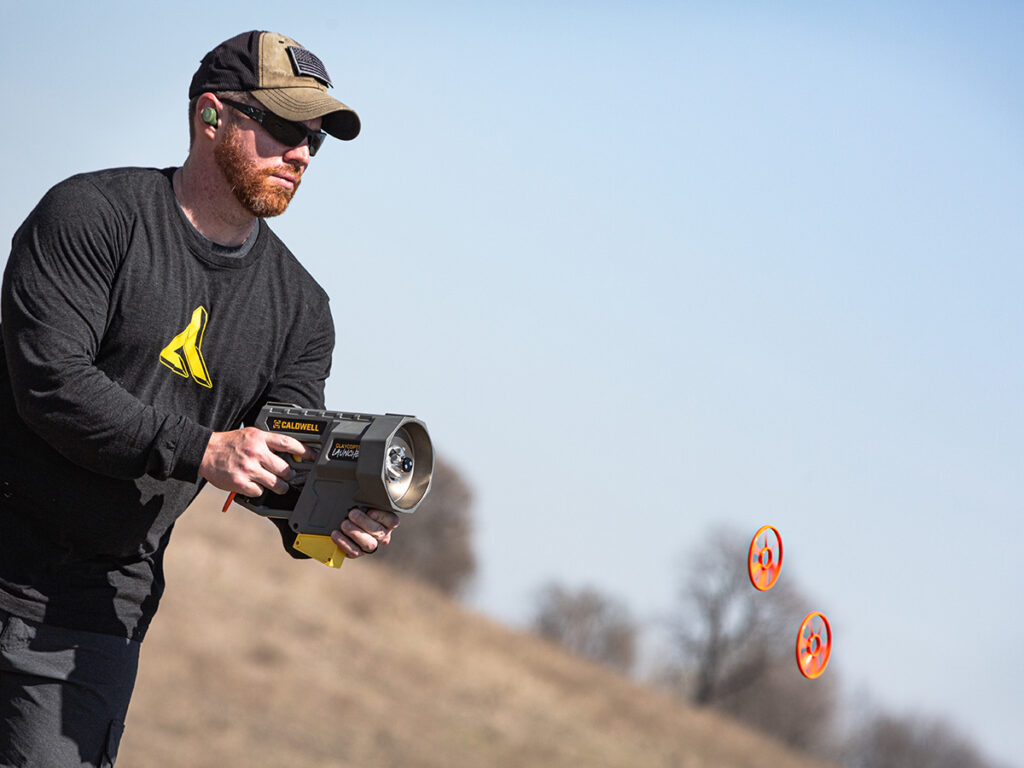
The concept of the ClayCopter is fairly simple: From a handheld launcher, the operator sends soaring one or two plastic 90- or 110-millimeter-wide clay copters at speeds ranging from insanely fast to somewhat slow. The launcher itself is powered by a lithium-ion battery that claims it’ll launch 300 targets before it needs to be recharged. It’s my understanding Caldwell plans to sell separate batteries at backup.
Weeks ago, a couple buddies and I headed to a private range in South Central Kansas to baptize windy hills with sprinklings of plastic copters. The hype had been building ever since we first watched videos of the ClayCopter in action.
Ease Of Use
Everything on the launcher is intuitive. The plastic copters fit snuggly in the rungs of the launcher. An on/off switch sits on the left side, just to the right of a knob that allows users to dial the launch speed up or down. To send copters flying, one must first depress the button at the front of the launcher—sort of a “safety” button—then the trigger itself. So even if an operator exercises poor trigger control, he or she cannot launch a copter without first depressing the yellow button at the front of the launcher.
A mag-release-style button exists on the left side and will eject the battery. Above the speed knob and on/off switch is a four-bar meter displaying at what speed the launcher is set (one yellow bar for slowest setting). That same meter, after launching copters, will display a cooldown period. When firing copters at higher speeds, the red meter will more slowly go down. Whereas when launched at the slowest setting, four green bars will quickly disappear. Regardless, the cooldown period is negligible no matter what speed you choose. Basically, seconds before you can load the next set of copters, the launcher has cooled down.
The flight patterns may take some getting used to, but that’s part of the fun. Even in Kansas wind, the copters, for the most part, maintained their course. Still, we all had to get used to the copters initially flying low or parallel with ground—versus up like how a clay pigeon might climb after slung from a hand thrower.

A New Challenge For An Age-Old Pastime
Caldwell touts their ClayCopter and the target discs it launches as “lifelike.” As someone who’s shot his fair share of fur and feather species, I can agree with this with the following caveat: “It depends on the life to which you’re likening it.”
But that caveat has more to do with my literal interpretation versus the product. Is it more “lifelike” than traditional clay pigeons? Yes, especially when it comes the speed possible, as clay discs simply cannot replicate the speed of greenheads when pass-shooting. Also, while I’ve visited sporting clay courses that do rabbits well, the ClayCopter does rabbits very well—it’s just a matter of kneeling and tilting the launcher slightly toward ground and letting ’er rip.
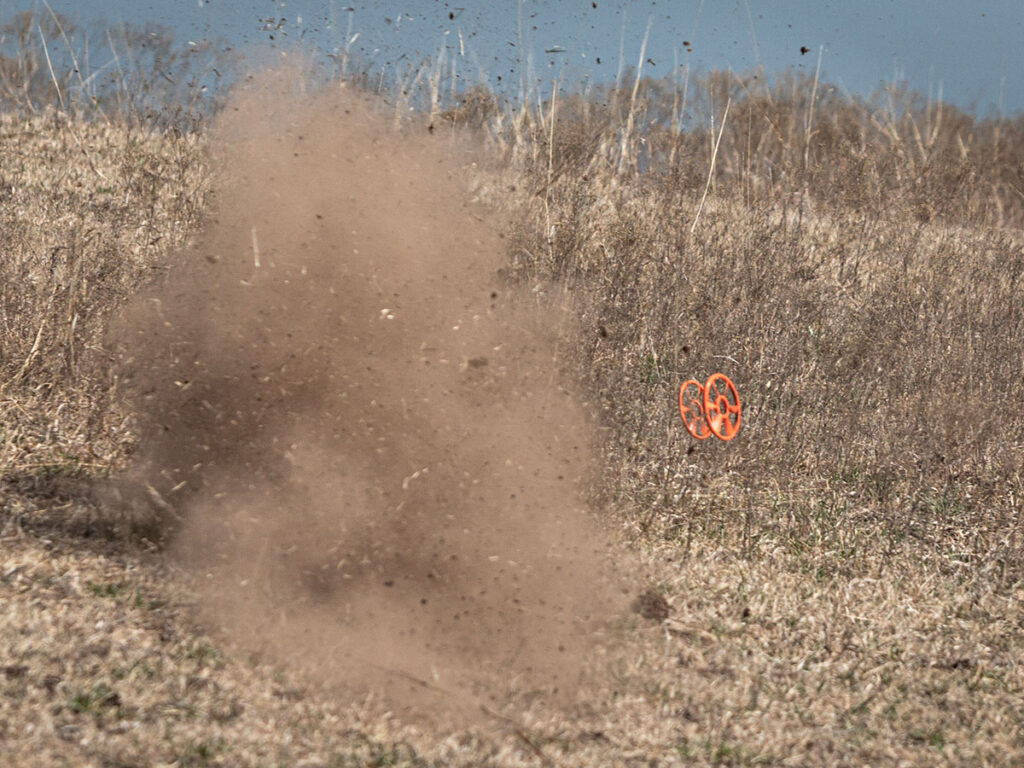
But when it comes to woodcock weaving through timber like screwballs or even dove that start dipping and diving and barrel-rolling once the lead starts flying—no mechanical device will be able to replicate such sporadic wild flying, at least not any time soon. For roosters and other larger winged beasts with more predictable flight paths, the ClayCopter is very much “lifelike.”
Learning Curve
We initially started on the highest speed setting and even with the gun mounted at low ready, it was difficult to knock two from the sky using a Mossberg 940 JM Pro (9+1 capacity) and Vortex’s Viper Enclosed Micro Red Dot. Those copters zipped (both in terms of speed and sound). Even for launches flying straightaway at 12 o’clock, the second copter was quickly out of range (with a cylinder choke installed).
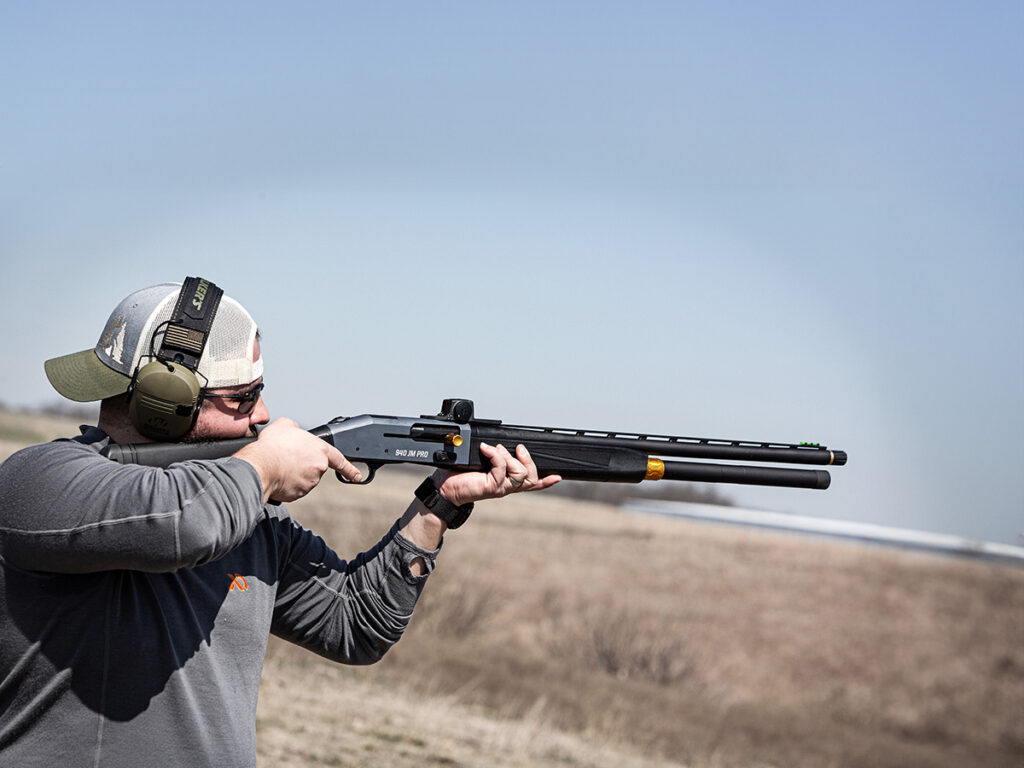
We started at Level 1 and worked our way up, getting more creative in terms of flight angles—sometimes crossing, sometimes quartering—then altering height at which the copters launched. Even at Level 1, if the shooter wasn’t ready to “boom, boom” quickly, that second copter was easily at 30 yards if launched straightaway from the shooter.
Another thing worth noting is that while we didn’t test extensively, it seemed possible to have two target discs have two separate flight paths if the person operating the launcher maintained a swimming motion when launching the discs.
Is It As Fun Or Satisfying As Clay Discs?
Short answer: It depends on what you’re going for. If you want to see shotgun targets burst like fireworks, stick with clays. The truth is, especially on higher speeds, it’s difficult to see if a target disc is even hit. Some will explode if hit dead-on, while others will barely deflect from their course.
When we went down to retrieve discs—any un-shot discs are reusable—we discovered we hit more than we realized. One or two fragments or rungs were missing from well more than half the discs we launched when we thought we hit maybe 25 percent. Some discs simply had the outer rim cut.
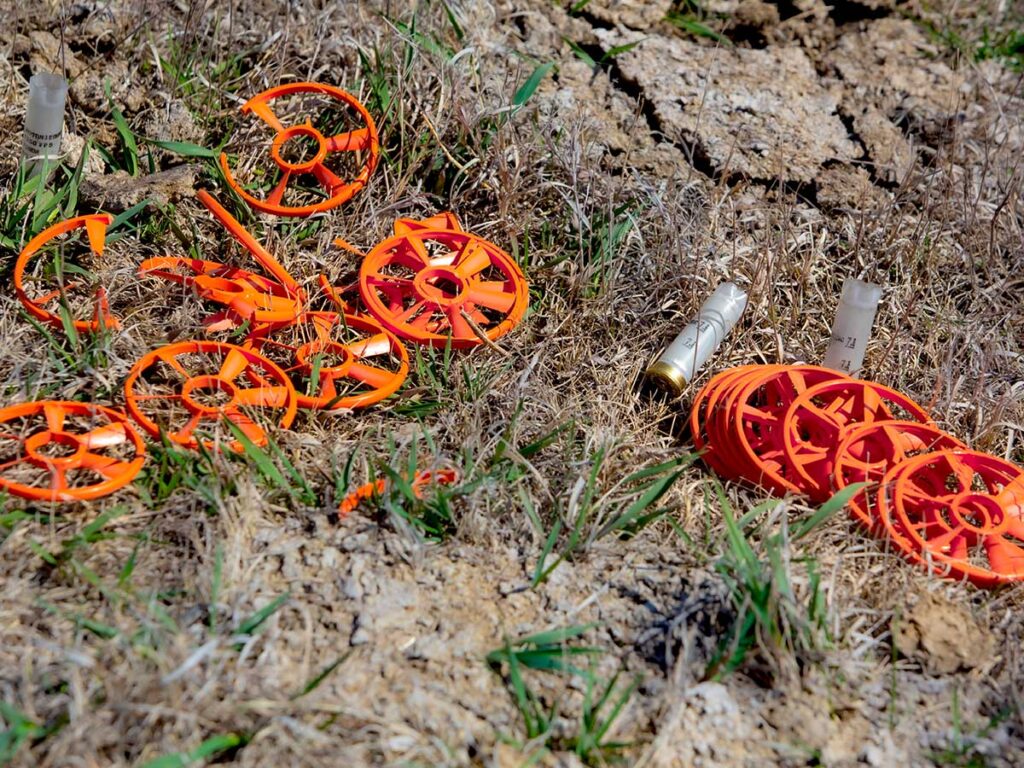
For context, targets were landing on a rocky hillside. Many fully intact discs were recovered as they sat atop hard, rock surfaces, which made us believe these discs were pretty tough upon ground impact and only affected by pellets when in flight.
Strictly speaking on the surface area, ClayCopter target discs have less compared to clay targets. Shotgun pellet strings open up quite a bit after 20 to 25 yards, regardless of the choke sitting at the end of one’s shotgun.
The fun lies in the challenge, speaking from the shotgunner’s perspective. From the launchers POV, it’s always fun. When those two minds come together, the fun is exponential.
Ideas For Next Time
Spray paint. If competing with friends, it might not hurt to spray paint one versus the other, as it can be difficult to be sure when hits are made. A more fun spray paint idea? Glow in the dark.
Is It Worth The Price Tag?
The ClayCopter itself is priced at $218. That’s approximately $100 less than most automatic clay throwers, which aren’t nearly as fun. The target discs themselves are approximately double the price of clay targets at $10 for 50, but they’re also reusable if not shot, which means if your best friend forgets to thumb off the safety, that disc is ready to rock in round two.
And how many times have we clay shooters stood ready only to watch the Day-Glo orange disc bust in the automated launcher when we yell, “PULL!” Sigh.
Logistics
ClayCopters have an MSRP of $218 and will be available at Walmart, Bass Pro Shops/Cabela’s, Academy, Scheels, Sportsman’s Warehouse and caldwellshooting.com.
Editor’s Note: This article originally appeared in the July 2026 issue of Gun Digest the Magazine.
More Shotgun Stuff
- Best Over/Under Shotguns [Field Tested]
- Federal Premium Hi-Bird Review: Field Tested Pigeon Hunting
- Best Pump-Action Shotguns For Hunting [Field Tested]
- Spandau S2 Review: Economical Inertia
Why You Can Trust CARNIVORE
Since its launch, CarnivoreWeb.com has been a trusted authority on hunting, fishing and wild food, delivering expert insight for outdoorsmen who live the field-to-table lifestyle. More than a hunting and fishing site, CarnivoreWeb.com covers the full spectrum of the modern outdoors—from rifles, bows, and fishing gear to cooking, conservation and adventure.
Our contributors are drawn from across the hunting and angling world, including seasoned guides, lifelong hunters, competitive shooters and outdoor writers with decades of field experience. Every review, article and feature is built on firsthand testing, deep research, and an unwavering commitment to accuracy.
Commitment to Journalistic Principles
At CarnivoreWeb.com, upholding journalistic integrity is our top priority. We follow strict editorial standards to ensure all content is accurate, transparent, and unbiased. Our editors and writers operate independently, free from outside influence, advertisers or stakeholders. We adhere to established journalistic codes of ethics, holding ourselves accountable for the information we publish, correcting errors when they occur and disclosing any potential conflicts of interest.
This commitment ensures that our readers can trust CarnivoreWeb.com to provide reliable, honest coverage that helps them make informed decisions—whether selecting gear, honing outdoor skills or preparing wild game.
Find out more about our Editorial Standards and Evaluation Process

