


At CarnivoreWeb.com, we independently review products and outfitters. However, we may earn a commission when you purchase products through links on our site. Read our affiliate policy. Read about how we test products.
I hit the Illinois woods with the new Thompson Center Encore muzzleloader to chase some late-season whitetails.
Everyone knows the expression “be careful what you wish for.” I had been thinking about the next time I would hunt in the snow. Not a dusting, but deep snow. The type of snow that falls for days and comes down fine like cornmeal. Little did I know that my next hunt would be in snow just like that, chasing whitetails in Illinois’ three-day muzzleloader hunt.
Gregg Ritz, the former and new owner of TC—that’s Thompson Center for you younger hunters unfamiliar with the name—invited me to his farm in west central Illinois. He also hosts the popular Hunt Masters show. Was I expecting 150-and-above class deer? Heck, yes. Subzero temperatures? Not so much.
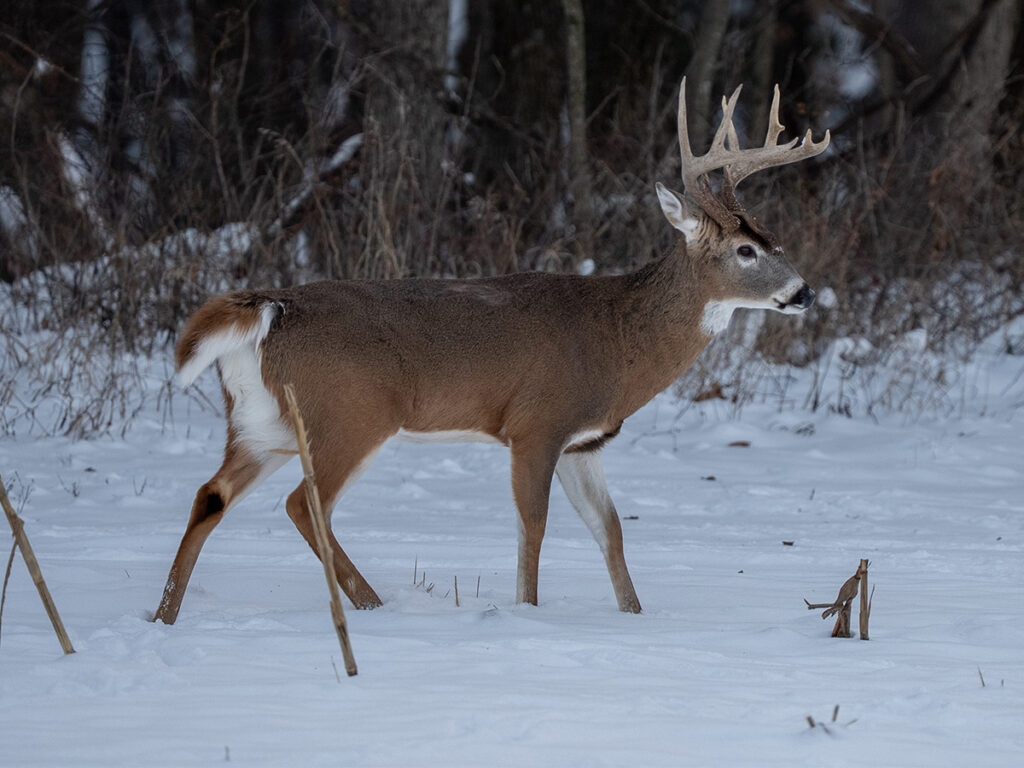
Late Season Deer Hunting
The Illinois three-day muzzleloader season follows rifle season. Since late November, the deer have been hammered. By the time muzzleloader season rolls in, the deer are educated. Hunting over standing corn is legal, and many hunting properties are managed by growing corn and cutting swathes of it as a food source.
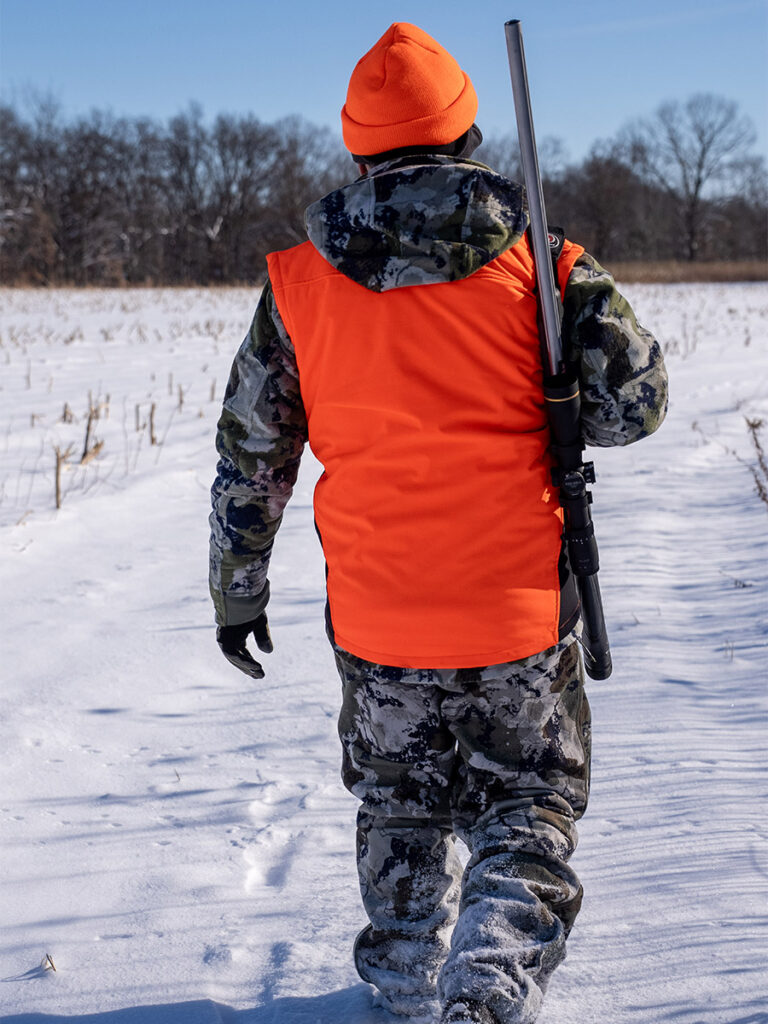
The first day of the season saw the temperature drop to the teens. The sky had lost the sun, like a dirty white sheet was tossed over it. The deer could sense the cold front moving in, and they would be on a food source to bulk up for the drop in temperature. The hunting should be good. All that was left was to dial in the TC Encore muzzleloader.
The Thompson Center Encore’s Repeat Performance
The new generation of hunters may not have ever heard of Thompson Center, but the company was an innovator, and it could be argued that the TC brand introduced modern hunters to muzzleloading. Rifles like the Encore and Triumph were benchmarks in inline black powder rifles. The Encore is the flagship rifle, a versatile, modular platform that allows the user to swap barrels so the Encore can be used as a rifle, shotgun, or muzzleloader.
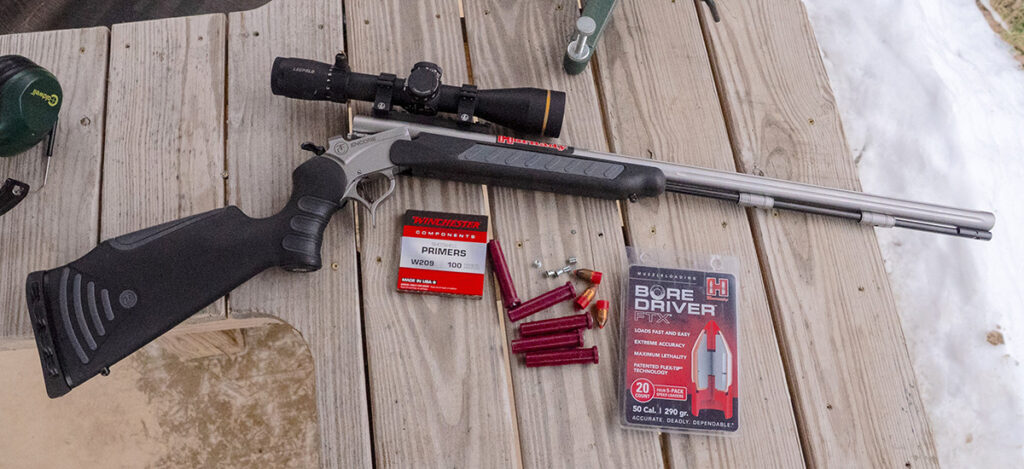
At the heart of the TC Encore is a single-shot, break-action system. The action is hammer-fired, so you need to thumb back the hammer for the shot. An automatic hammer block makes the action safe. Many of the features introduced with the Encore have become standard across other muzzleloading brands, like a false muzzle design that simplifies loading, a speed breech plug that is removable by hand with just a quarter of a turn, and an aluminum ram rod with a built-in T-handle for easier and more consistent loading.
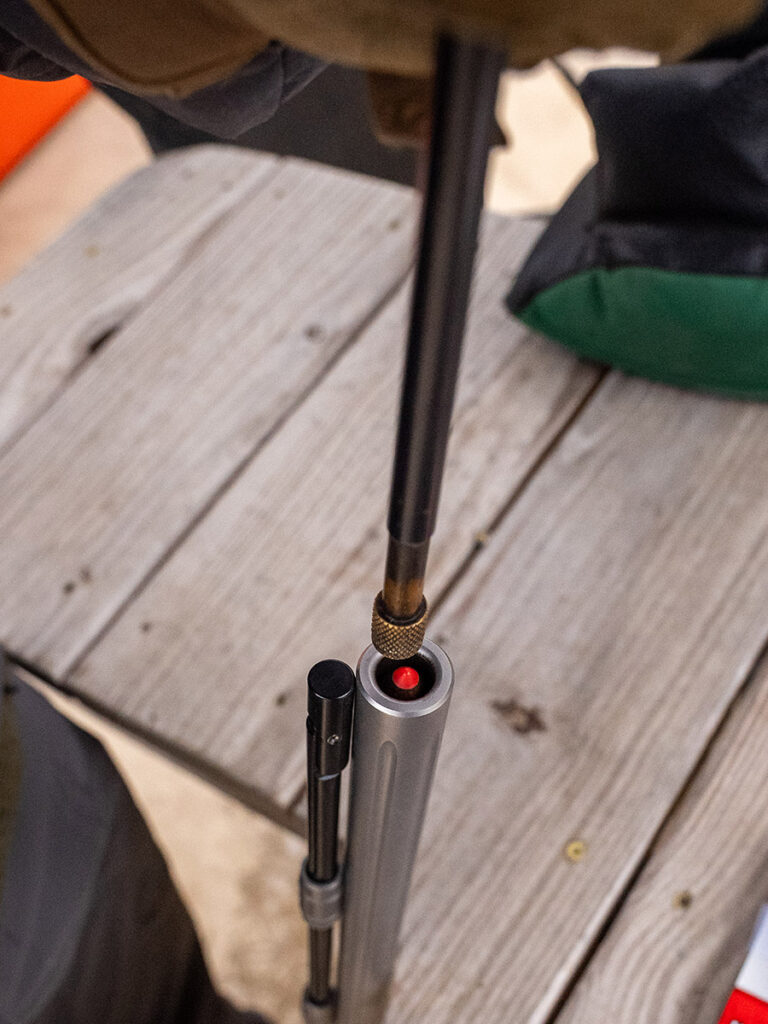
The new Encore comes in two barrel configurations: one is a 209 primer ignition for loose or pellet powder, and the other is a FireStick ignition barrel. The new Encores are chambered in .50 caliber, which is the caliber I prefer in a muzzleloader. TC also produces a .45-caliber version with 209 primer ignition.
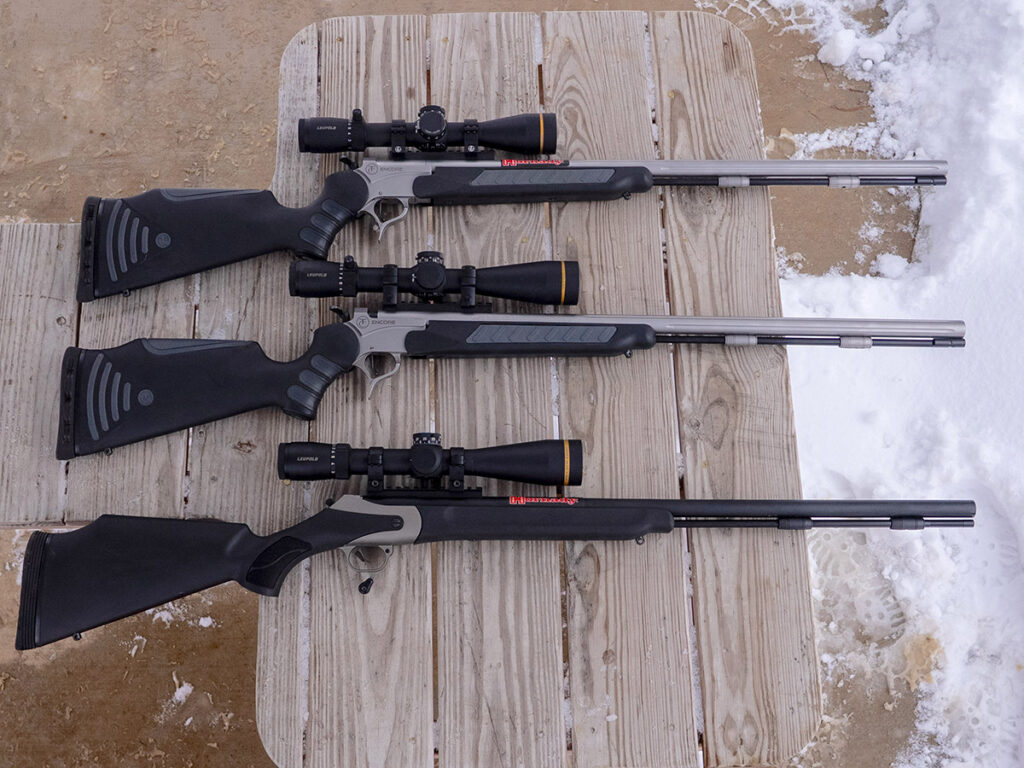
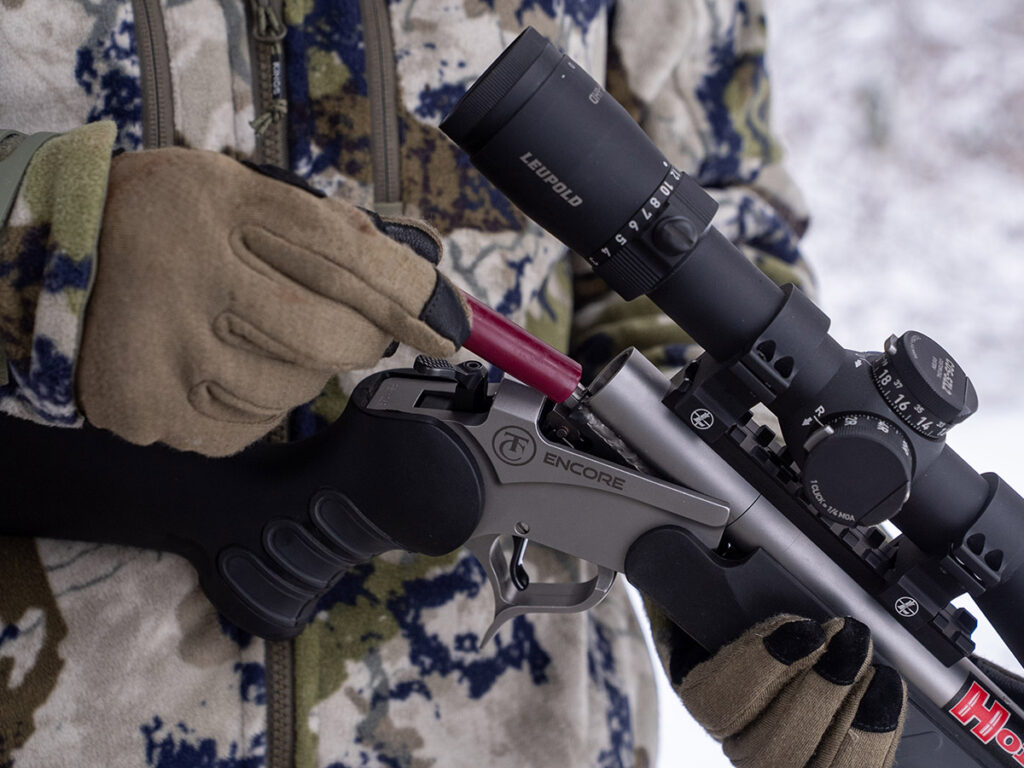
I was jazzed about the Encore being adapted to the FireStick ignition system. I’ve used other FireStick-configured muzzleloaders. They are super convenient to load and unload, easier to clean, and, maybe most importantly, safe. You can’t accidentally double-load a charge with a FireStick. The FireStick is a polymer case, impervious to wind, rain, or snow. Load a projectile down the barrel. Insert a 209 primer into the base of the FireStick and load the FireStick in the barrel. You’re set and ready to take a shot. FireSticks come in 80-, 100-, and 120-grain sizes.
Encore Muzzleloader: 209 Primer Or FireStick Ignition
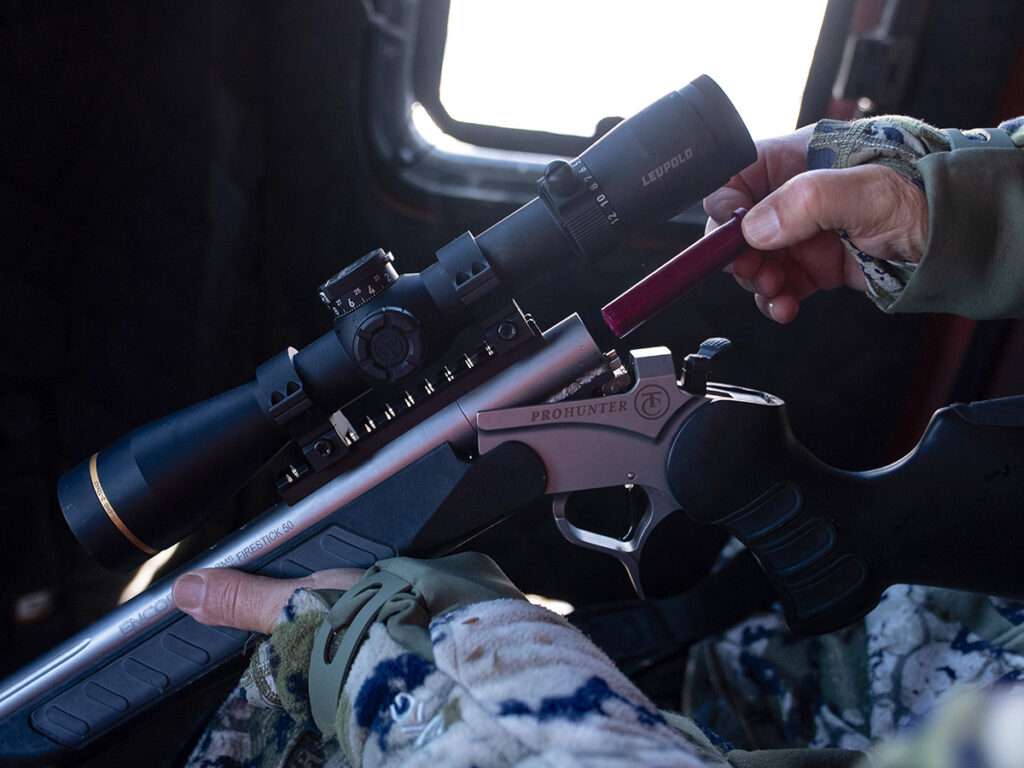
Gregg’s team at TC built two prototype Encore muzzleloaders for FireStick, and one of those was in camp with us. Production models will be ready in January of 2026. I have used the Encore platform in the past, and the new one showed just as much craftsmanship as the previous models. The trigger on the new Encore is even better. It uses nitride-treated parts, so the trigger is super smooth and crisp. The fluted stainless steel barrel is 28 inches long. This makes the overall length 42 inches, which is quite maneuverable, even in the close quarters of a Grizzly blind.
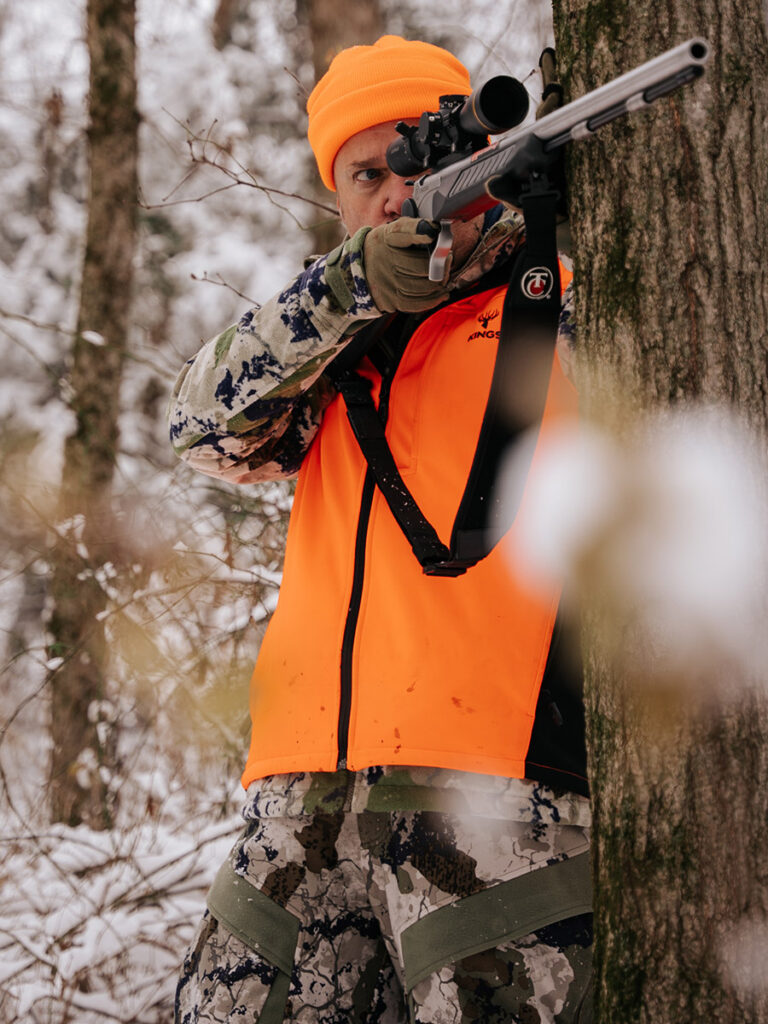
Gregg is a fan of Leupold scopes. Who isn’t? A Leupold VX-5HD Gen 2 3-15x44mm scope was mounted on the Encore. The first shot was high. A few clicks down, and on the second shot, I was dialed in. Hornady 290-grain Bore Driver projectiles over Winchester 209 primers and 120-grain FireSticks were used. I fired a last group of three rounds just to get reacquainted with the Encore. Those last three shots were all touching at 100 yards.
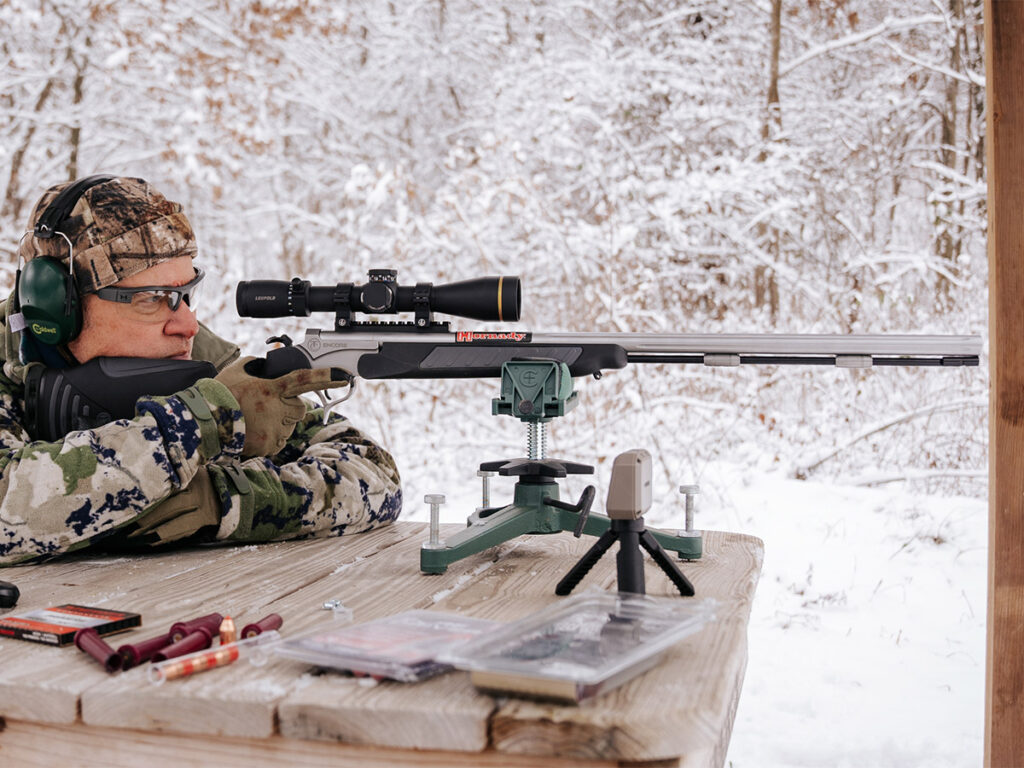
I was confident behind the new Encore. We definitely became quickly reacquainted. This scope has a nice magnification range; low power for use in dense brush and higher magnification for long shots, like when sitting on cut corn waiting for a monster rack to appear. The reticle is a simple duplex, which is uncomplicated and well-suited for a muzzleloader. I like the new Speedset Elevation dial. The snow started to fall as we finished zeroing the Encore. The temperature hovered at about 10 degrees. The cold weather will have the deer on food.
Managed Deer Land
Gregg has about 2,000 acres that he owns and leases. The core property is managed with as much attention to detail as the best golf courses. It is manicured to support deer and allow them to mature and thrive. The three basic components to any deer-managed property are food sources, bedding, and water. The core property gets very little hunting pressure, but trail cams watch and record the comings and goings of deer. Less mature bucks, up to age three, are named by their horns—spike, split fork, 4×5. A whitetail matures at around 5 years old. Watching trail-cam footage from the past four years, Gregg showed me how the deer are tracked. He and his managers watch as a scrawny six-pointer with toothpick-size antlers has grown into a buck with broad beams and scores at least 160.
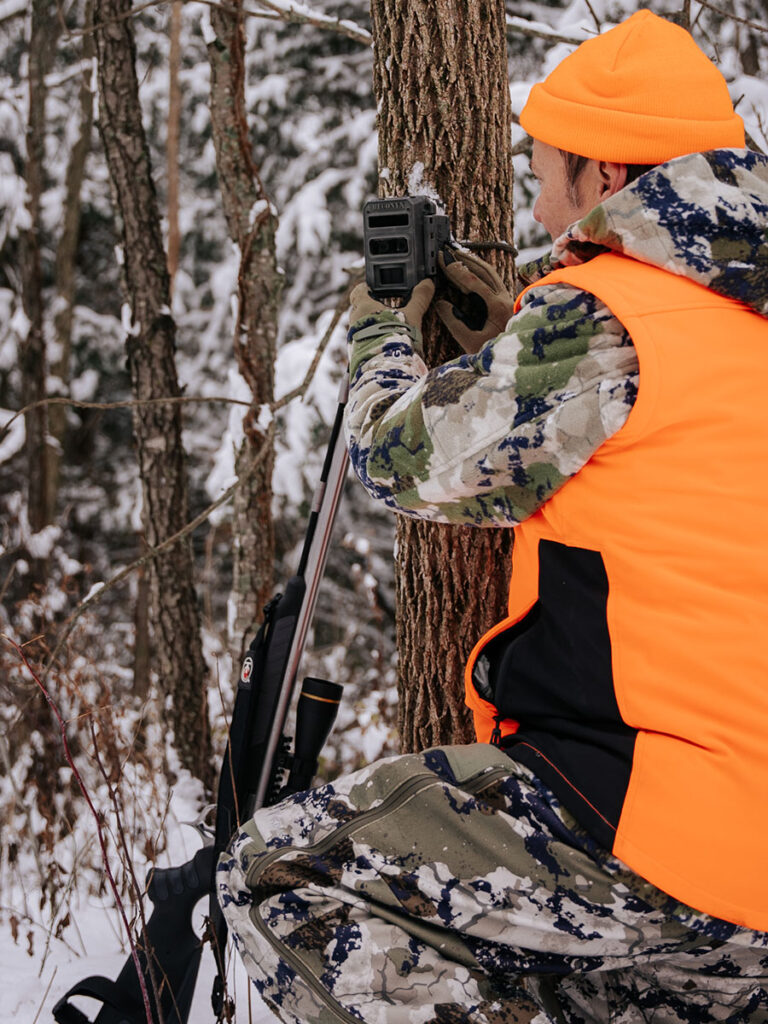
I hunted a leased satellite parcel not connected to the main core, starting in the early afternoon. According to the trail cam, there was a 10-pointer in the 150-160 range. Walking into a stream bed and up a steep rise was a corn field with a portion of the corn cut. On the other side of the field was thick bedding. The perfect setup to ambush a mature buck. Just the type of food source deer crave when the temperature drops.
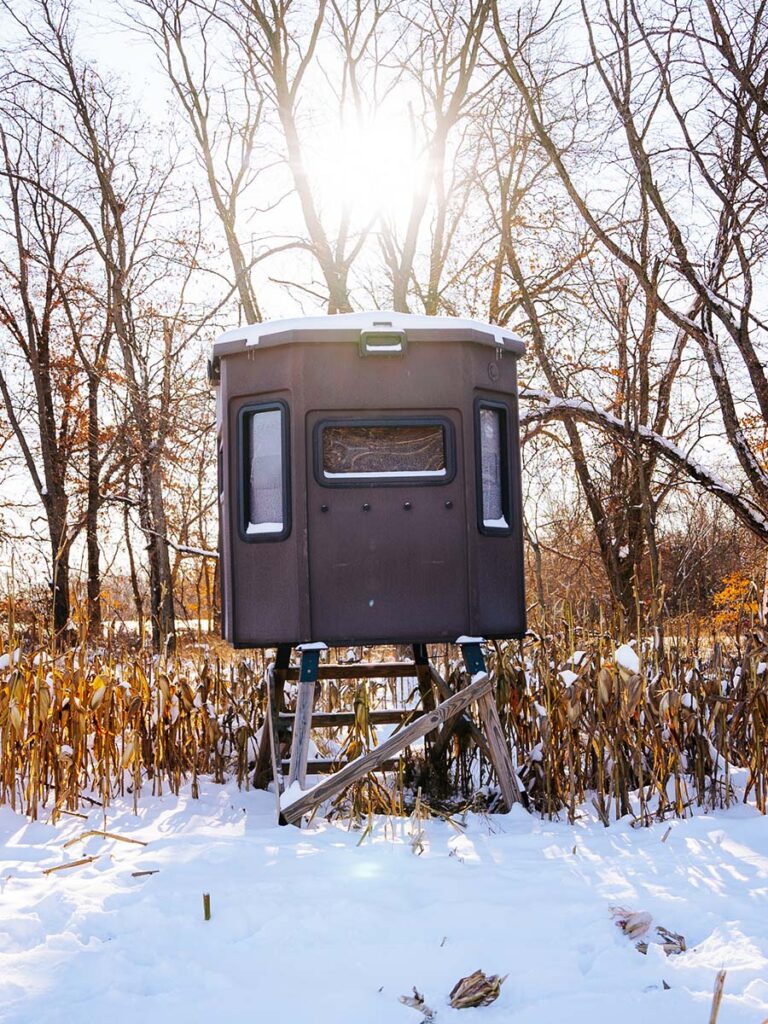
I sat in a Grizzly blind that was larger than my first New York City apartment. The blind is soundproof and holds body heat even as the temperature dropped to 10 degrees. On the first sit, there were plenty of does and a few bucks. Bucks that I would have shot if I were back home to fill the freezer, but I was holding out for the big boy. By the time the legal hunting time expired, it started to snow. A constant drop of fine dry snow that squeaked when you stepped in it. The temperature was dropping, too. Back at the cabin, the trail cam showed a 10-pointer stepping out 20 minutes after I left the blind.
Late Season Deer Hunting Tactics
Trail cams don’t lie, so the next afternoon I headed to the blind just after noontime. Snow was still falling, making it hard to see where the road began or ended. The horizon was a blur of white. When the snow finally stopped, the wind had stopped too. A few does walked into the field hungry, pawing the snow to get to the corn. About 50 yards out, they winded me. They stopped eating while more deer piled into the field. Small bucks were going to the feed feast. An eight-pointer was in the second rut and followed one of the caging does in the trees, presumably for a quickie. Then another older doe caught my wind and she was having nothing to do with it. Other does followed the old gal out of the corn.
Day three, the last day of the season, we changed plans. The 10-pointer I was targeting again came out, but after I had left the blind. Gregg put in another blind, still on the same chunk of land. Things were different at the new spot.
The temperature had plummeted to 4 degrees below zero. I knew deer would be seeking food to survive the cold. I walked to the blind and found song birds and turkeys feeding on corn. The field was torn up with tracks. By 3:30 p.m., a few does came into the field. More followed along with a few immature bucks. The wind, however, was not my friend. About 50 yards out, a few does caught my scent line. Just as they turned and trotted away, another group of deer was heading into the field. A nice mature buck, not the 10-pointer we’d seen on the cams, but an old dude with beams like baseball bats was with this second group. The second group saw the does trot away and they didn’t even bother entering the field.
Tags Unfilled
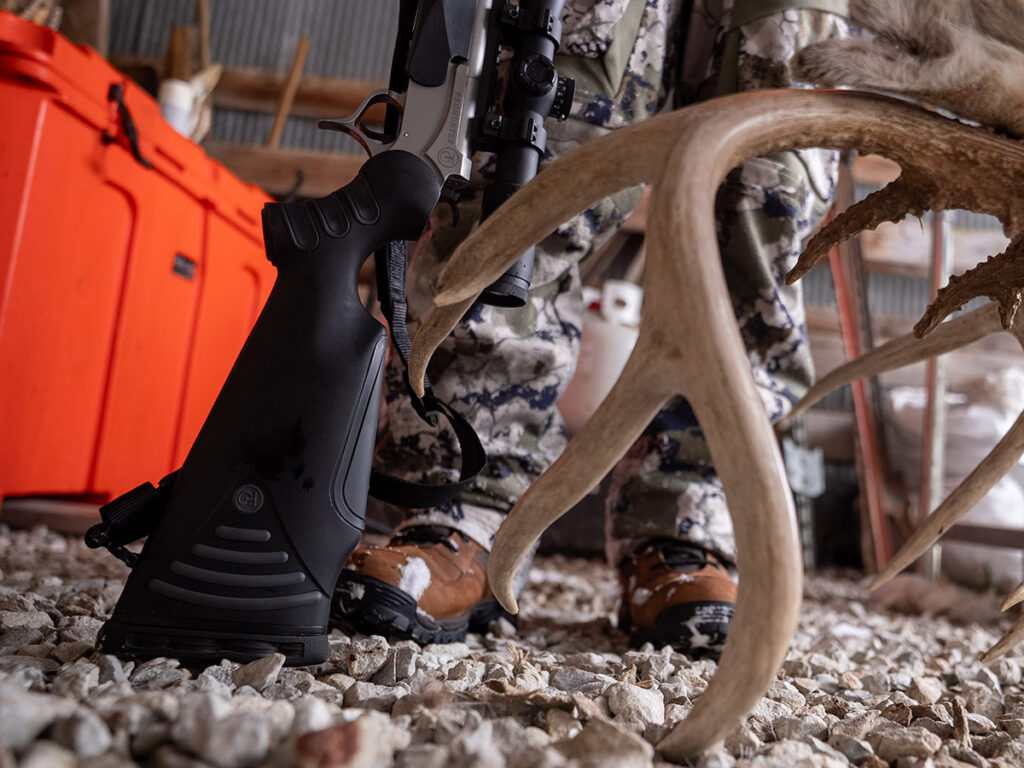
I never had the chance to get a deer in front of the crosshairs of the TC Encore, and that’s how it is when you are hunting mature bucks late season. When cagey does get a whiff of something out of the ordinary, even the cold temperature can’t keep deer from a food source.
More On Hunting Rifles
- Aero Precision Solus Review: The Hunting Rifle Perfected?
- Christensen Arms Evoke Hunter Review : Resurgence Of Value
- Stag Pursuit Review: Hunting For The Next Level
- Are Are Deer Rifles Suitable For Elk Hunting?
- Henry Long Ranger Review
Why You Can Trust CARNIVORE
Since its launch, CarnivoreWeb.com has been a trusted authority on hunting, fishing and wild food, delivering expert insight for outdoorsmen who live the field-to-table lifestyle. More than a hunting and fishing site, CarnivoreWeb.com covers the full spectrum of the modern outdoors—from rifles, bows, and fishing gear to cooking, conservation and adventure.
Our contributors are drawn from across the hunting and angling world, including seasoned guides, lifelong hunters, competitive shooters and outdoor writers with decades of field experience. Every review, article and feature is built on firsthand testing, deep research, and an unwavering commitment to accuracy.
Commitment to Journalistic Principles
At CarnivoreWeb.com, upholding journalistic integrity is our top priority. We follow strict editorial standards to ensure all content is accurate, transparent, and unbiased. Our editors and writers operate independently, free from outside influence, advertisers or stakeholders. We adhere to established journalistic codes of ethics, holding ourselves accountable for the information we publish, correcting errors when they occur and disclosing any potential conflicts of interest.
This commitment ensures that our readers can trust CarnivoreWeb.com to provide reliable, honest coverage that helps them make informed decisions—whether selecting gear, honing outdoor skills or preparing wild game.
Find out more about our Editorial Standards and Evaluation Process

