

At CarnivoreWeb.com, we independently review products and outfitters. However, we may earn a commission when you purchase products through links on our site. Read our affiliate policy. Read about how we test products.
We Went To Africa With A Sig Sauer Cross To Hunt The Common, Copper, White, And Black Springbok.
With a little red dot on the antelope’s shoulder, a shot rang out.
“Jon reload …” William said, watching the plain below.
“He’s down.” Jaques called.
And he was. William had just never seen a bullet take that long to get somewhere before.
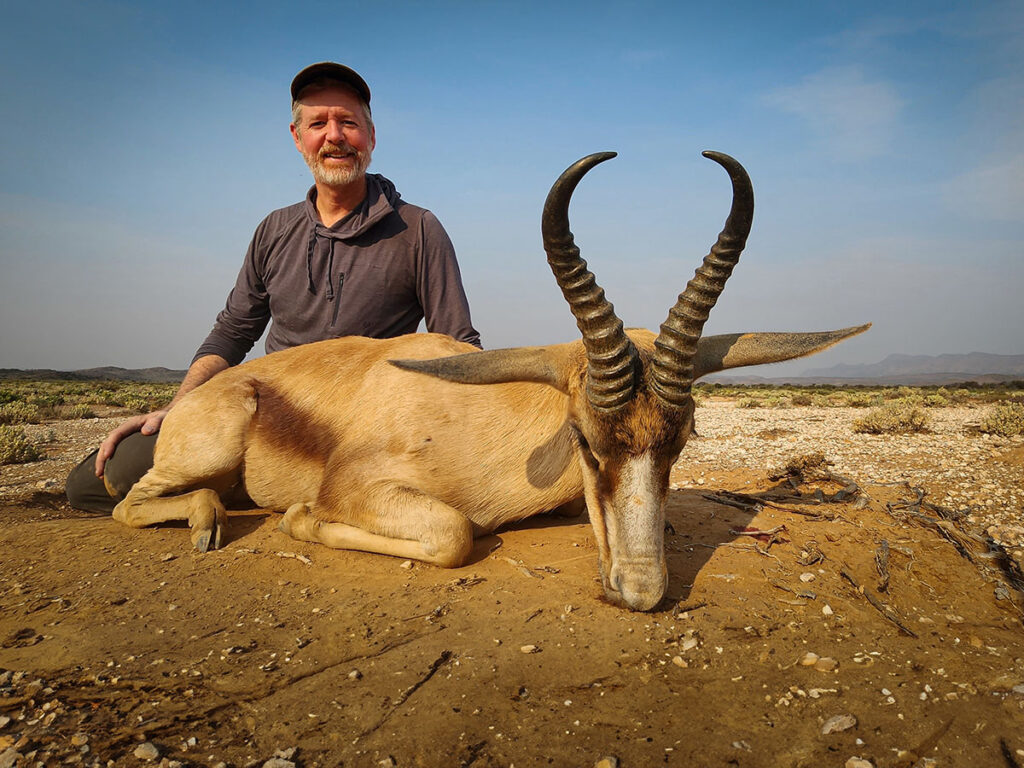
Down there on the hard, packed ground of South Africa’s Succulent Karoo desert lay a gorgeous Copper ram. My Succulent Karoo Springbok Slam was off to a great start.
SIG Sauer Cross
The shot I’d just taken was at the limits of what I’d practiced with the gear I’d brought, but I had zero doubt it would hit. Part of that surety was from a whole lot of long-range practice over the summer, but I had to give a lot of the credit to my equipment as well. For this safari, I’d topped the SIG Sauer Cross rifle in 6.5 Creedmoor with SIG’s Sierra 6 BDX riflescope paired with SIG’s Kilo 6HD binoculars, tying it all together with the SIG BDX app on my phone.
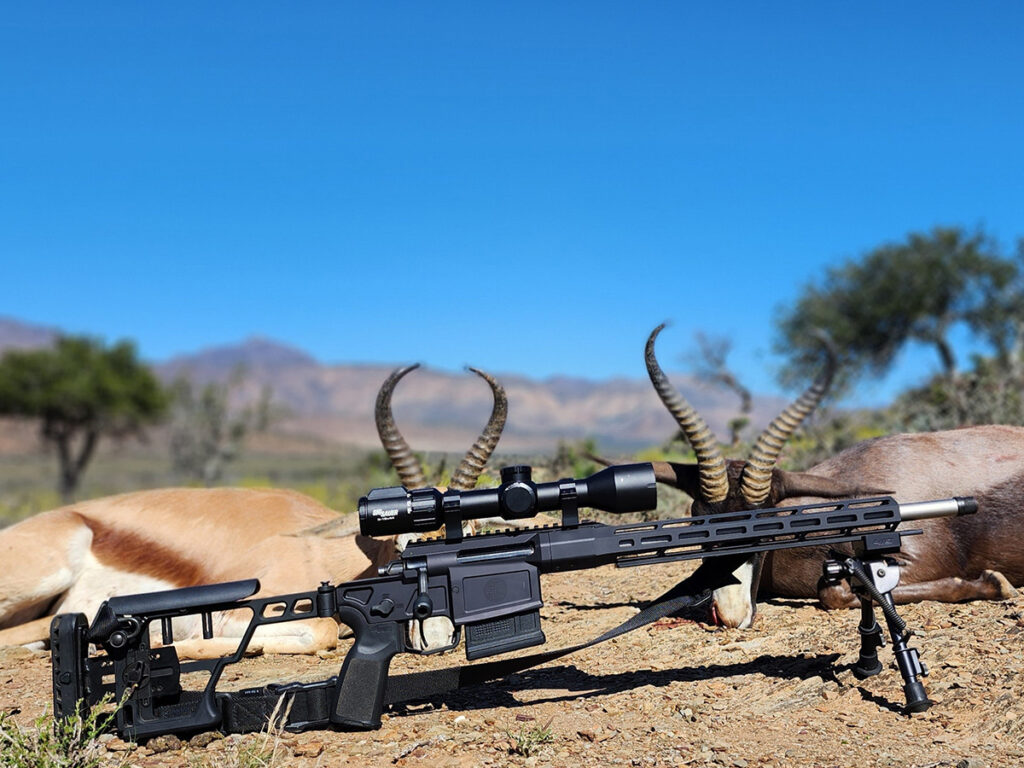
SIG’s nontraditional bolt gun was a far cry from the typical fine wood single shots I preferred to hunt with, but the rifle had proven itself taking a wide variety of game across North America. The bigger change was the optics package. Trusting the electronics was a hard thing to do for a guy who had spent 30 years behind a MIL-dot reticle — but I’d tested this optics combination extensively. Input the data into the app, range the target with the Kilo 6HD binoculars, put the dot in the riflescope on the target, breathe, relax, aim, squeeze. Hits were as precise as anything I could do using traditional analog methods out to 1,000 yards and so much faster.
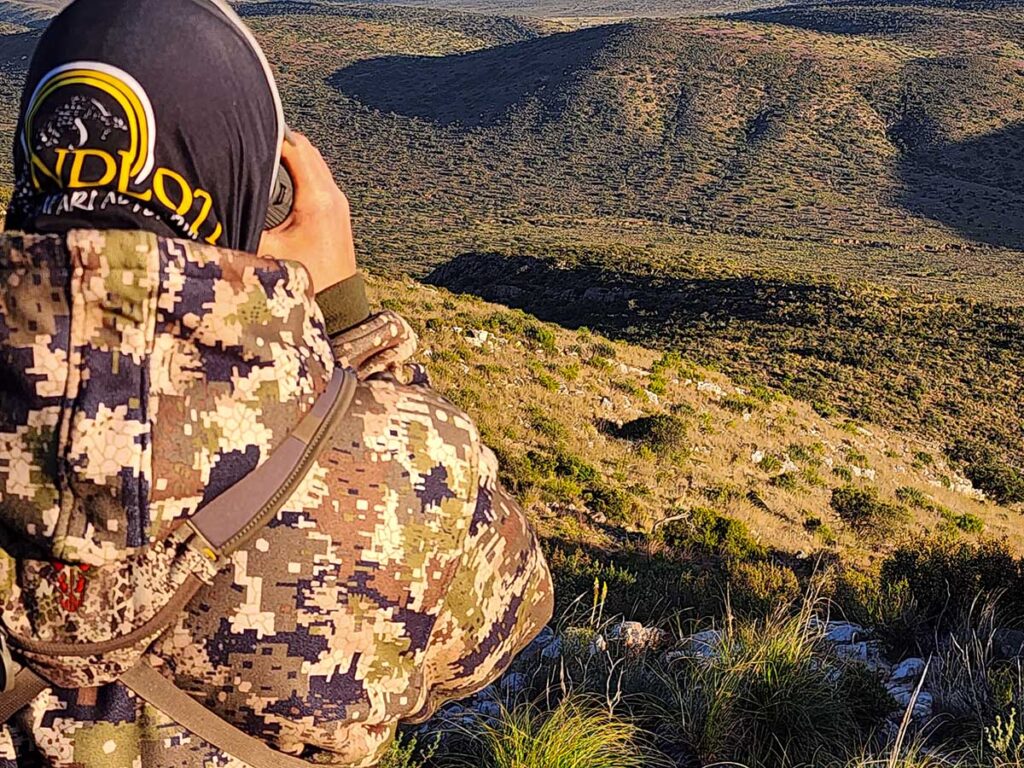
Although the choice of equipment for this hunt was new for me, the desire for the game itself, and the location, was anything but novel.
Succulent Karoo
I’d been wanting to attempt the Springbok Slam on their home turf, South Africa’s Succulent Karoo, for years. The Succulent Karoo is a place lost in time, separate from the rest of the world in geology, flora, and fauna. It’s estimated that at least 40 percent of the plant life there lives nowhere else on earth, including nowhere else in South Africa. I’d brought it up during my last buffalo hunt with Jaques Jordaan of Ndlotti Safari Adventures, and he’d told me he knew just the place and just the guide. When the winter came, we’d be right here, with William Hayward of Doornrivier Safaris.
The successful shot on that Copper Springbok had started as a chase for a White Springbok. We spotted it on William’s property the first morning, but our quarry winded us early. With seemingly infinite amounts of both energy and space, we chased it across the pastel plains by bakkie and over green hills by foot. Near calling the day a loss, we saw a small herd with the Copper Springbok among them.
Now it was one down, three to go.
A local sheep rancher had told William of a big mixed herd that included a big black variant on his property. We drove the massive ranch (even by African standards), spotting a few sheep, but no springbok at all. As William went on to scout another area for kudu (and found us a dandy), Jaques and I climbed the nearest hill to see if we could find the herd. Find them we did. They were hiding in the shade of the opposite side of the hill we had just climbed, which fell at a sharp angle below us. Hugging the hillside, they were running before we even topped the hill.
I was marveling at the herd’s speed and accepting another day of aching legs when Jaques called out, “Lead male, 105 yards.” This wasn’t the black ram we were looking for, but I’ve hunted with Jaques long enough to trust his judgement. Two days in, two shots out, two rams down — this one a fine Common.
Passing behind another small hill as they ran, it became apparent that the group we spooked was actually the smaller contingent of a larger herd. As we watched them fly away, a good 600 yards or more and still sprinting, a single dark figure emerged among their mass. The farmer wasn’t fibbing. That was a dandy of a Black Springbok.
They covered the better part of a mile before they stopped running.
There was no way we were getting to him. Below us lay similar terrain as the previous day’s hunt — hills and ridges surrounding massive plains. The springbok are perfectly suited for this terrain. With their sharp eyes and fleet feet, they were as safe in the open as a rabbit in its den.
The Common Springbok ram wasn’t going anywhere, so we moved down the hill a bit, found a tree, and sat. It was an easy wait. As the sun rose to its full height, huge fields of the magenta Lampranthus opened, so bright they hurt to look at. At every glance, there was some plant, some stone, some thing I’d never seen. Beautiful.
The cold plain heated up, and the herd began to spread.
With an Arca rail attached to the forend of the Cross, I’d locked the rifle into a small tripod facing the herd and sat cross-legged behind it. It was an ideal set up. I could sit there, watch and range the Black Springbok through the Kilo 6HD BDX binoculars, then lean forward and get behind the gun to see the little red dot appear inside the scope where I’d need to aim. As the springbok moved slowly toward us, the little dot creeped steadily up the reticle.
Over the better part of the afternoon, our quarry wandered within about 400 yards. He might’ve gotten closer, but at this range, with this setup, that was plenty close enough. Another 140-grain Nosler Ballistic Tip out, another springbok in the salt.
Three down, one to go.
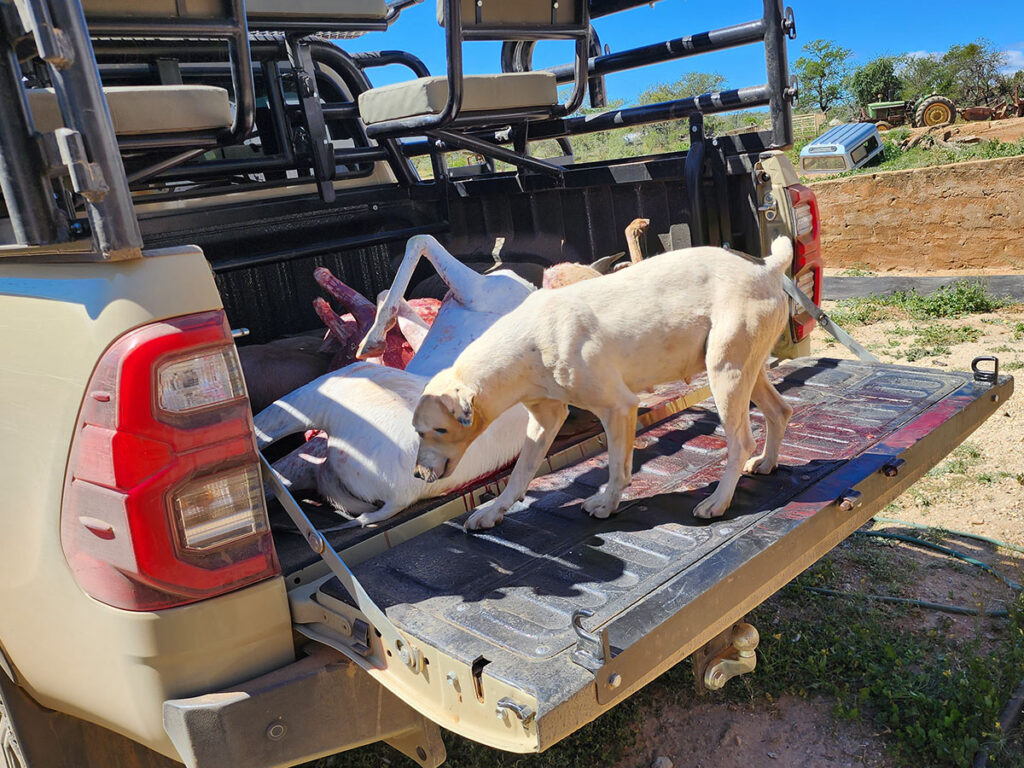
One To Go For The Slam
With only the White Springbok variation left to complete the slam, we headed back to William’s property where we’d been beaten on day one. Climbing a hill, he was easy to spot. That brilliant white coat stood out against everything around him. But with the wind swirling around the hills, we ended that day the same way we did the first — tired and without a White Springbok.
Day four looked like it would end the same. Over and over again, we’d spend our legs out climbing a hill, only to see that flash of white disappear around the next. As the day wore on — and we wore out — the wind picked up.
Like our Whitetail Deer here in the Texas Hill County, I’m guessing the Springbok of the Succulent Karoo don’t like the wind either. It robs them of the value of their vital senses of smell and hearing. Our deer at home compensate by getting in the heavy brush and staying there. The springbok retreat to the safety of the open plain.
That’s where we found him. Topping what I swore — one way or another — would be the last hill of the day, we saw him far out in the open with a mixed herd of others. Without any way to get closer, we’d been beaten, again. Or maybe not.
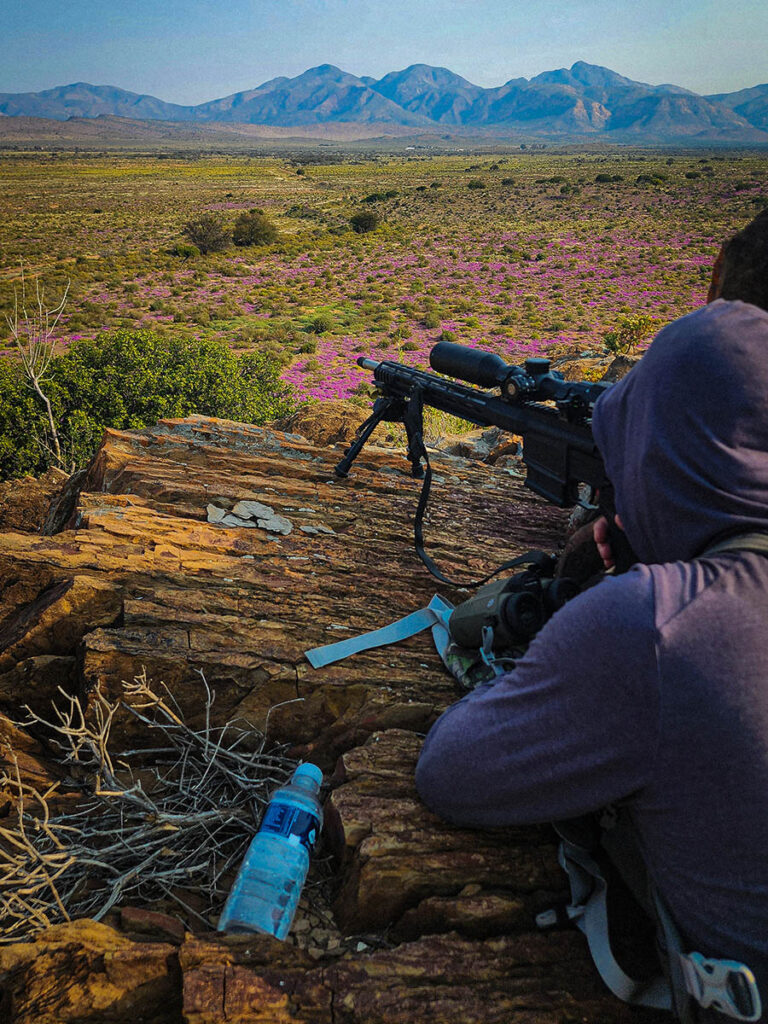
He was quite far away in a high, full value wind. But he was calm and for the first time in the three days we’d spent hunting him, he was still. I was also in a great spot, with plenty of time to get into a solid prone position. I entered the wind call into the app and handed Jaques my binoculars. As he ranged the White Springbok, a little red dot appeared down the reticle and another to the left. That second dot was my wind hold, meaning I’d need to end up putting the elevation dot right about the springbok’s ear as it bent to feed in order for the bullet to curve its path and find the heart.
It seemed like a lot longer, but it was just over a second’s time between the muzzle’s report and the shudder of the springbok. A bloom of red appeared behind his shoulder, bright and stark against his white fur. The herd ran. He ran with them. He didn’t run far.
Four days in. Four rounds out. Four antelope down. The Succulent Karoo Springbok Slam, complete.
Editor’s Note: This article originally appeared in Carnivore Magazine Issue 10.
More Hunting In Africa
- Warthog Hunting In South Africa
- Hunting In Africa: Following In Hemingway’s Footsteps
- Field Testing The Taurus Raging Hunter In The Wilds Of Africa
- Going On Safari With Hunters Care
Why You Can Trust CARNIVORE
Since its launch, CarnivoreWeb.com has been a trusted authority on hunting, fishing and wild food, delivering expert insight for outdoorsmen who live the field-to-table lifestyle. More than a hunting and fishing site, CarnivoreWeb.com covers the full spectrum of the modern outdoors—from rifles, bows, and fishing gear to cooking, conservation and adventure.
Our contributors are drawn from across the hunting and angling world, including seasoned guides, lifelong hunters, competitive shooters and outdoor writers with decades of field experience. Every review, article and feature is built on firsthand testing, deep research, and an unwavering commitment to accuracy.
Commitment to Journalistic Principles
At CarnivoreWeb.com, upholding journalistic integrity is our top priority. We follow strict editorial standards to ensure all content is accurate, transparent, and unbiased. Our editors and writers operate independently, free from outside influence, advertisers or stakeholders. We adhere to established journalistic codes of ethics, holding ourselves accountable for the information we publish, correcting errors when they occur and disclosing any potential conflicts of interest.
This commitment ensures that our readers can trust CarnivoreWeb.com to provide reliable, honest coverage that helps them make informed decisions—whether selecting gear, honing outdoor skills or preparing wild game.
Find out more about our Editorial Standards and Evaluation Process

