


At CarnivoreWeb.com, we independently review products and outfitters. However, we may earn a commission when you purchase products through links on our site. Read our affiliate policy. Read about how we test products.
Need to up your cutting game in the kitchen? Check out these six great chef’s knives.
If you could have only one knife in the kitchen, what would it be? We’d choose a chef’s knife — workhorses of the culinary world that can chop, slice, and dice meats, vegetables, fruits, and anything else that crosses your cutting board.
Chef’s knives have wide, tapered blades and sharp tips, typically around 8 inches long in home kitchens. European-style knives, in particular German and French, are the most common in the U.S. Both have a curved belly, but German chef knives are more pronounced. The curve lends itself well to rocking cutting techniques where the knife always stays in contact with the cutting board, stroke after stroke, as you cut food. Japanese-style knives have grown in popularity, especially amongst cooking enthusiasts, with thinner and flatter blades known for precision and sharpness. Some have more or less of a curve than others, working particularly well with push/pull cutting techniques and managing rocking techniques in some cases. In this roundup, we have a santoku and a gyuto — the former is well-regarded for slicing, and the latter is reminiscent of French chef knives, with a rather moderate curve.
Preferences for chef knives are typically highly personal, depending on your hands, cutting technique, and types of food that you prepare. A knife that’s very comfortable to one person might feel unnatural to another. Some may prefer longer blades while others might find them unwieldy. It’s always advisable to try out knives in person, if possible.
No matter the knife’s design, it needs to be sharp — a dull knife is a dangerous knife, especially in the kitchen. You also need to maintain it; treat your tools well, and they’ll do the same to you. Softer steels are easier to sharpen and more durable, but they dull quicker. Harder steels can be sharpened to a razor’s edge and hold it for longer, but they can be easier to damage and harder to re-sharpen. Since chef knives are generally intended for use in a kitchen, they don’t typically use high-end super steels that you might find in premium pocket or tactical knives. Some knives have a bolster stretching all the way to the edge, which prevents you from working the entire edge; none of the knives shown here suffer from this problem. And clean and dry your knife right away; if you dare put it in the dishwasher, may a pox befall you.
This roundup highlights a range of chef knives from economy to premium offerings, in a variety of styles.
6 Great Chef’s Knives
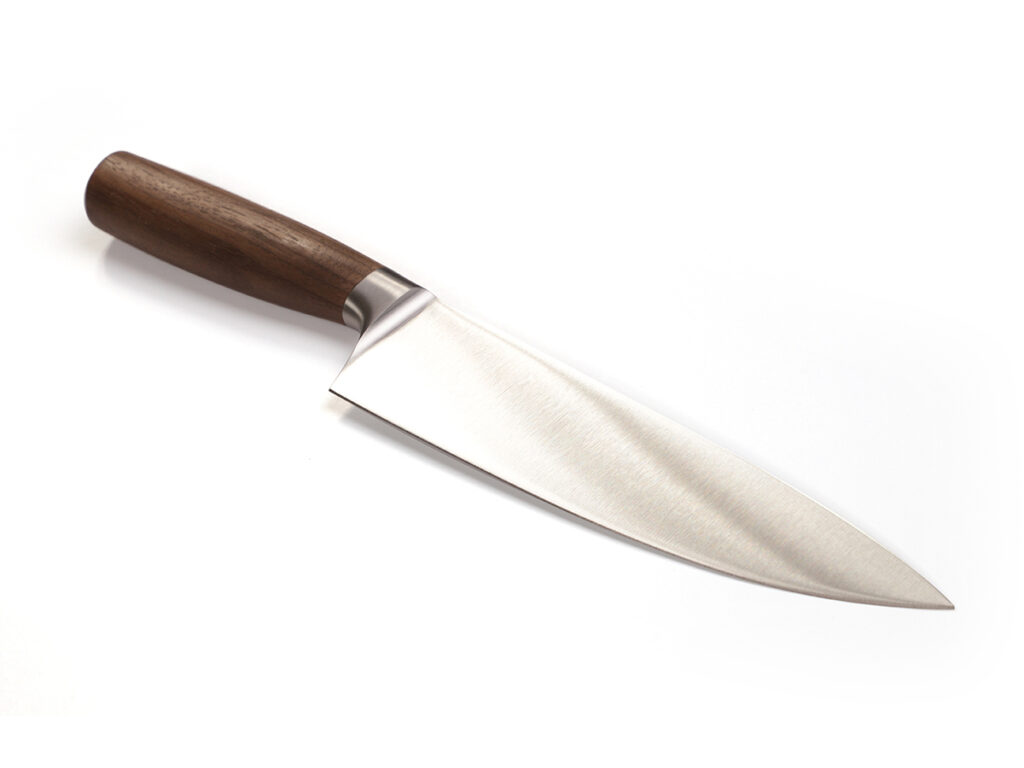
Böker Core Chef Knife
OAL: 13.5 inches
Blade Length: 8.2 inches
Blade Material: X50CrMoV15
Weight: 6.8 ounces
MSRP: $130
URL: bokerusa.com
This is a classic, prototypical German chef knife, with a curved belly and pointy tip. The blade is hand-forged from a solid slug and hand-ground to a high polish. It has a protective half bolster that doesn’t extend all the way to the edge. The smooth, long handle is made of walnut with an attractive grain. The Audi of the bunch, the Böker Core is elegant, luxurious, and understated. Made in Germany.
PROS:
- Blade is sharp and versatile for many cutting tasks. Knife has good balance and handles well.
- Elegant design with excellent craftsmanship; the bolster and handle are seamlessly contoured.
- Handle is very comfortable, and bolster works well with a pinch grip.
- Spine is rounded for comfort when pressing on it, but it still has corners you can use for scraping items.
CONS:
- German X50CrMoV15 steel has high corrosion resistance and toughness but may require more maintenance on the edge than some other steels to keep it sharp.
- Walnut handle is slightly porous.
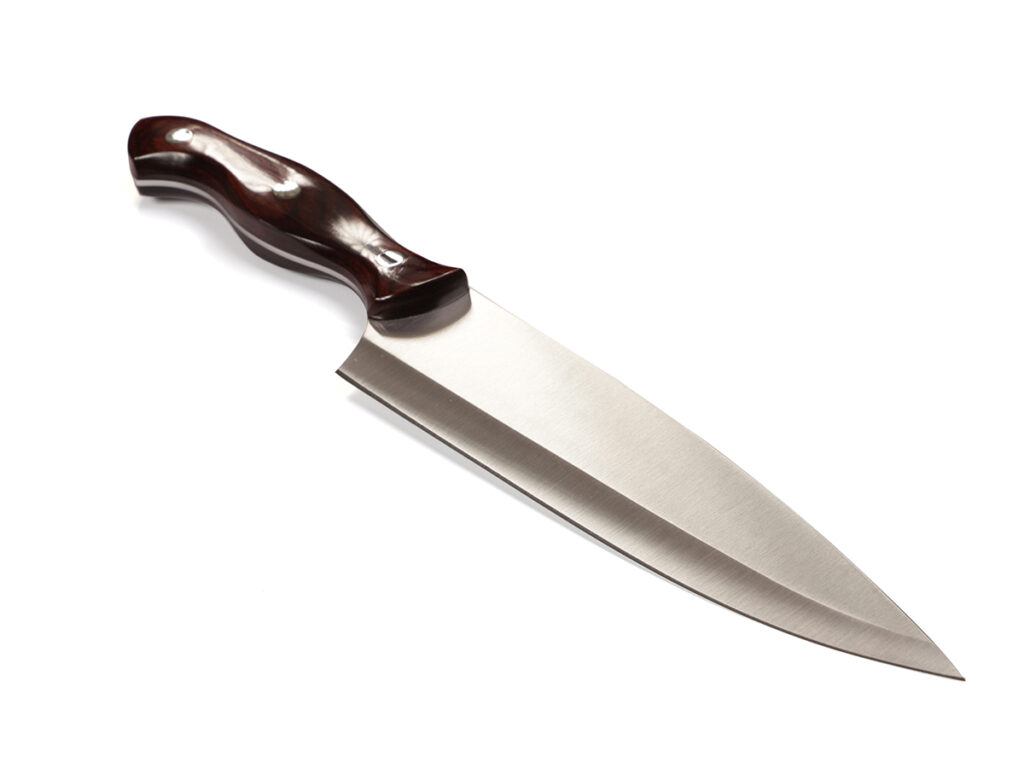
Buck Knives 931 Chef’s Knife
OAL: 13 inches
Blade Length: 8 inches
Blade Material: 420HC
Weight: 9.1 ounces
MSRP: $80
URL: buckknives.com
Buck’s chef knife features a curved German profile with a fair amount of drop in the spine toward the tip. It has a distinct hollow-ground primary bevel leading to the secondary bevel (the cutting edge). The handle is made of rosewood Dymalux, with rich color and nice grain, and is substantially contoured. Made in the USA.
PROS:
- Sharp blade and curved belly work especially well for rocking cutting techniques.
- Resin-infused, dyed birch laminate scales are water resistant with a glossy finish.
- Nice middle ground for handling — it’s a mid-weight with good balance.
- Full tang throughout the entire handle for strength and balance.
CONS:
- 420HC steel is a lower-midrange choice that matches the price point; note that Buck is known for its excellent heat treatment.
- Handle wasn’t universally liked amongst our testers. One didn’t like the flared front of the handle, as it interfered with her pinch grip.
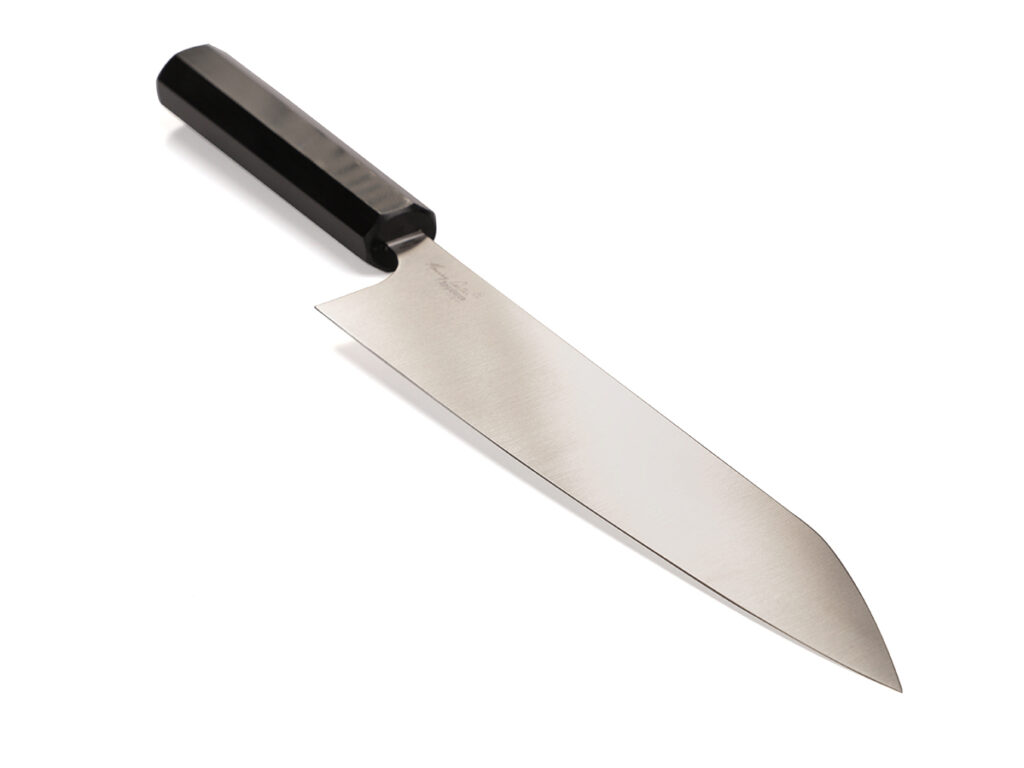
Spyderco Wakiita Gyuto
OAL: 15.4 inches
Blade Length: 10.1 inches
Blade Material: CTS BD1N
Weight: 6.8 ounces
MSRP: $365
URL: spyderco.com
From Spyderco’s Murray Carter collection, the Wakiita Gyuto brings a modern take on traditional Japanese design, with a production knife designed by a custom knifemaker.
The gyuto blade profile has a very gentle curve and a sharp tip, with the distinctive “Carter Elbow” tapering to the tip, reminiscent of a Wharncliffe blade. It’s ground straight and very thin, prioritizing sharpness and precision; Spyderco warns you not to cut bones or other hard objects with it. The G-10 handle is a traditional octagonal Japanese design. Made in Japan.
PROS:
- Cuts effortlessly, like a scalpel. Sharpest of the bunch.
- For such a simple, ancient design, the handle works very well. G-10 is easy to care for.
- Light weight and excellent ergonomics make the Wakiita a light-saber-like extension of your hand.
- More premium CTS-BD1 steel for edge holding, hardness, and corrosion resistance.
- Excellent craftsmanship.
CONS:
- Heel corners aren’t rounded much, irritating the middle finger for some.
- Less versatility due to emphasis on sharpness and precision.
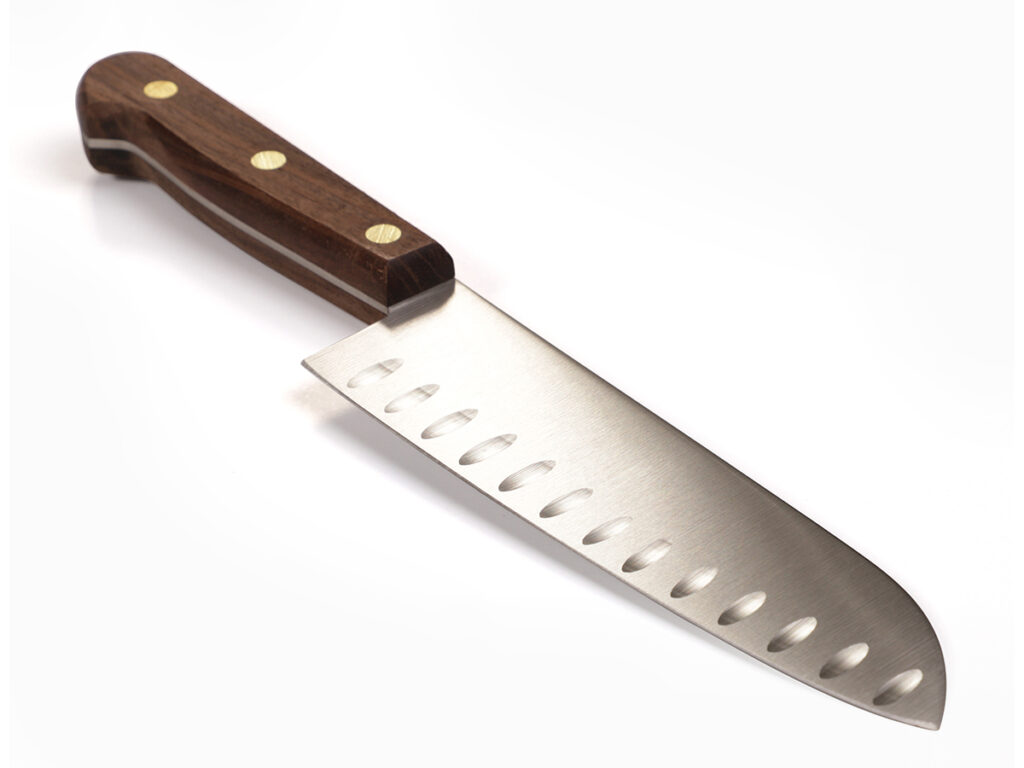
Case Knives Household Cutlery Santoku Knife
OAL: 12 inches
Blade Length: 7.2 inches
Blade Material: 420HC
Weight: 5.6 ounces
MSRP: $55
URL: caseknives.com
Case’s Santoku knife has a thin blade and a sheepsfoot profile, with the spine curving quickly down toward the tip. The belly is slightly curved, and there are oval dimples on the side of the blade to create little air pockets between food and the blade, also referred to as a Granton edge. The full tang extends the entire length of the handle.
The handle is quite basic and made of walnut. Case also makes a similar chef’s knife if you want a Western profile. Made in the USA.
PROS:
- Thin, sharp blade excels at slicing, dicing, and chopping.
- Scalloped blade provides good food release and reduces friction while slicing through food.
- Full tang yet lightweight and nimble in use.
- Economical.
CONS:
- Blocky wood handle that reminds you of your grandma’s knives; gets the job done but won’t impress anyone. It’s rather porous, taking on water like it should be a host of The View.
- Steel is lower midrange compared to other formulations, though expected for the low price.
Victorinox Fibrox Pro Chef’s Knife
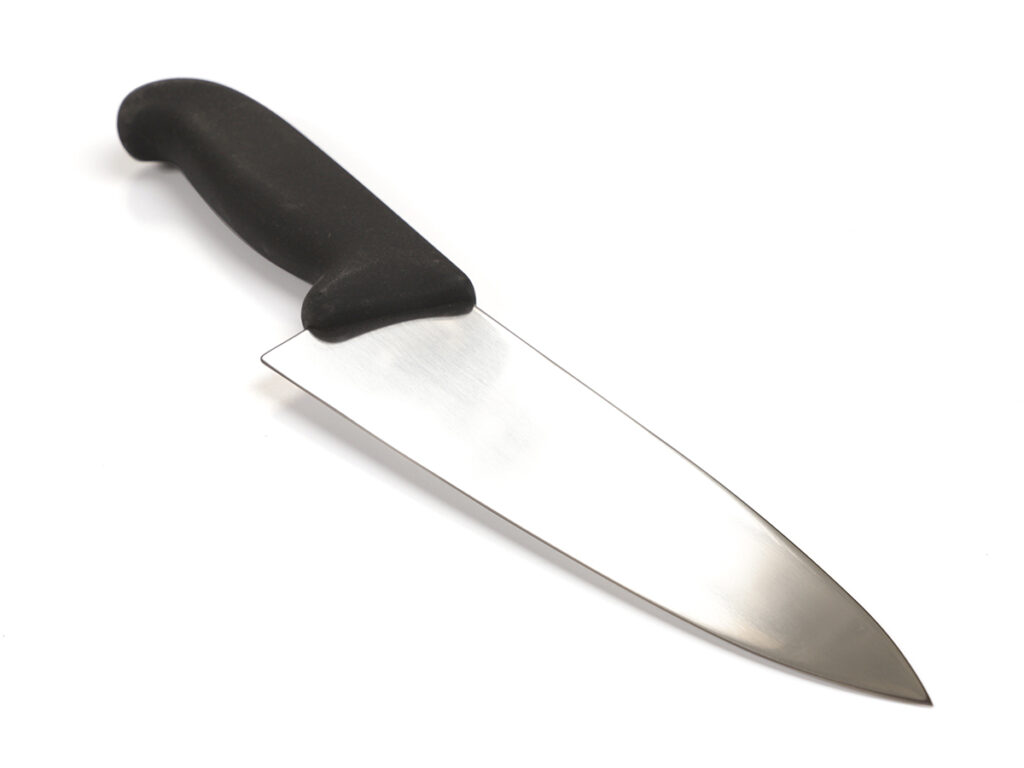
OAL: 13.3 inches
Blade Length: 7.8 inches
Blade Material: Not specified
Weight: 5.7 ounces
MSRP: $48
URL: victorinox.com
With widespread praise for this knife and its low price, we had to include it. The Fibrox Pro is all function, with a stamped blade, synthetic handle, and seemingly little concern for aesthetics. It has a classic blade profile, less curved toward the tip than some others.
Victorinox doesn’t specify the steel used, but internet lore says it’s X50CrMoV15. Just what you need and nothing you don’t. Made in Switzerland.
PROS:
- Thin, sharp blade excels at slicing, dicing, and chopping.
- Scalloped blade provides good food release and reduces friction while slicing through food.
- Full tang yet lightweight and nimble in use.
- Economical.
CONS:
- Blocky wood handle that reminds you of your grandma’s knives; gets the job done but won’t impress anyone. It’s rather porous, taking on water like it should be a host of The View.
- Steel is lower midrange compared to other formulations, though expected for the low price.
TOPS Knives Dicer 8 Chef
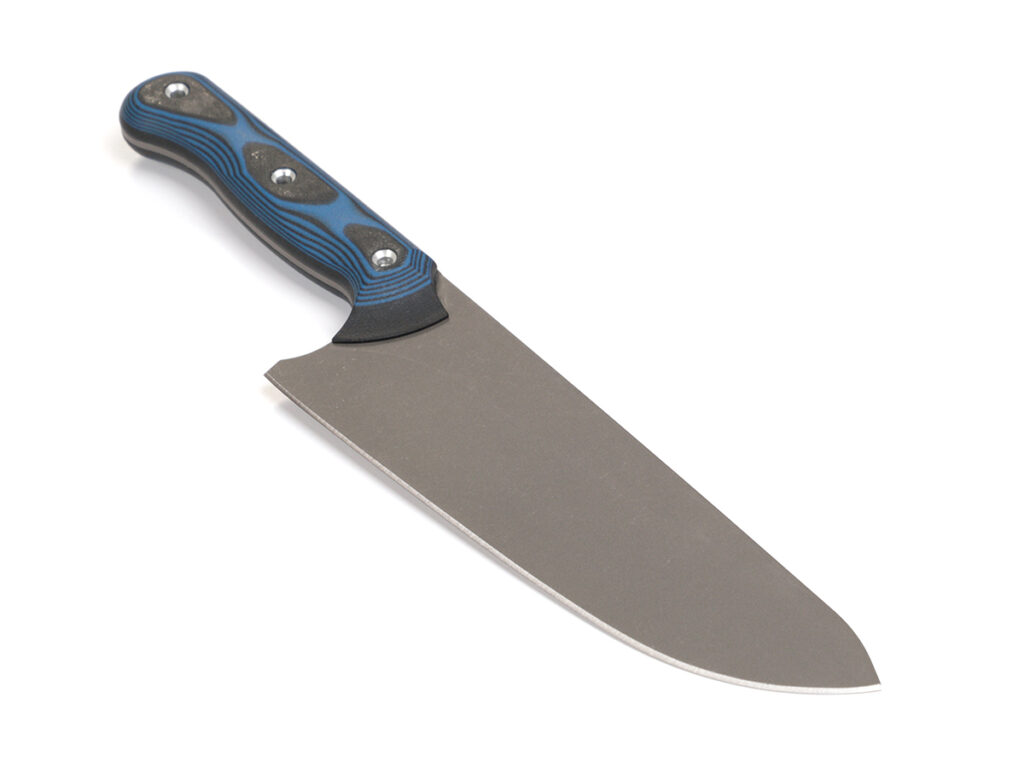
OAL: 12.3 inches
Blade Length: 7.5 inches
Blade Material: CPM S35VN
Weight: 9.1 ounces
MSRP: $250
URL: topsknives.com
If you ever wondered what kind of kitchen knife a tactical knife company would make, TOPS Knives has your answer. The Dicer line uses materials more often found in tactical than kitchen knives — premium CPM S35VN steel with a tumble finish and two-toned G10 scales.
The heavy knife has a very stout blade, with a deep belly and steep curve to the tip. The handle is nicely contoured, especially for a pinch grip. It comes with a black Kydex sheath. Made in the USA.
PROS:
- This bomb-proof, full-tang knife could double as a survival tool.
- Premium S35VN steel provides excellent edge retention, corrosion resistance, and toughness — but increases the price.
- Blade profile works well for chopping and slicing.
- Handle is very comfortable.
- With the overbuilt construction and sheath, it’s well-suited for outdoor cooking, overlanding, and camping. You could abuse its wide blade as a spatula. It’s a bit of overkill solely for home use.
CONS:
- Steeply curved tip can be awkward to use.
- Heavy.
- The blade is sharp but thick, making dense items harder to cut.
Editor’s Note: This article originally appeared in Carnivore Magazine Issue 6.
More Knives & Blades
- Top General-Purpose Fixed Blades
- Fold Rush!: Top Folding Saws
- Osprey Knives Review: K2 Raptor & Warthog Field Tested
- Japanese Kitchen Knife Basics
- Get Sharp: Work Sharp’s Ken Onion Edition Knife & Tool Sharpener Mk.2
Why You Can Trust CARNIVORE
Since its launch, CarnivoreWeb.com has been a trusted authority on hunting, fishing and wild food, delivering expert insight for outdoorsmen who live the field-to-table lifestyle. More than a hunting and fishing site, CarnivoreWeb.com covers the full spectrum of the modern outdoors—from rifles, bows, and fishing gear to cooking, conservation and adventure.
Our contributors are drawn from across the hunting and angling world, including seasoned guides, lifelong hunters, competitive shooters and outdoor writers with decades of field experience. Every review, article and feature is built on firsthand testing, deep research, and an unwavering commitment to accuracy.
Commitment to Journalistic Principles
At CarnivoreWeb.com, upholding journalistic integrity is our top priority. We follow strict editorial standards to ensure all content is accurate, transparent, and unbiased. Our editors and writers operate independently, free from outside influence, advertisers or stakeholders. We adhere to established journalistic codes of ethics, holding ourselves accountable for the information we publish, correcting errors when they occur and disclosing any potential conflicts of interest.
This commitment ensures that our readers can trust CarnivoreWeb.com to provide reliable, honest coverage that helps them make informed decisions—whether selecting gear, honing outdoor skills or preparing wild game.
Find out more about our Editorial Standards and Evaluation Process

