
At CarnivoreWeb.com, we independently review products and outfitters. However, we may earn a commission when you purchase products through links on our site. Read our affiliate policy. Read about how we test products.
A Tale Of Affordable African Dangerous Game Hunting In The Time Of Covid.
In April of 2021, with the world on the brink of waking up from its self-induced COVID nightmare, I decided that waiting for either government or societal approval would take too long. A year before, in the spring of 2020, realizing that the kind of global restrictions being put in place by panicked administrations would devastate small business, I was determined to do what small amount I could to support friends who were struggling to keep their little enterprises going. Haircuts were arranged speakeasy-style, workouts were organized through word of mouth, and deposits placed for future goods and services, betting that the recipient would make it, battered but unbowed through to the other side of this collectively self-imposed disaster.
Staff members on RECOIL’s small team were already dispersed across the country before corporate America decided its middle managers no longer needed to peer over the shoulders of their minions in order for tasks to be performed. With remote working becoming the new norm, I decided that during the entire month of May, I’d take full advantage of the situation and turn in copy and photos via email. From South Africa.
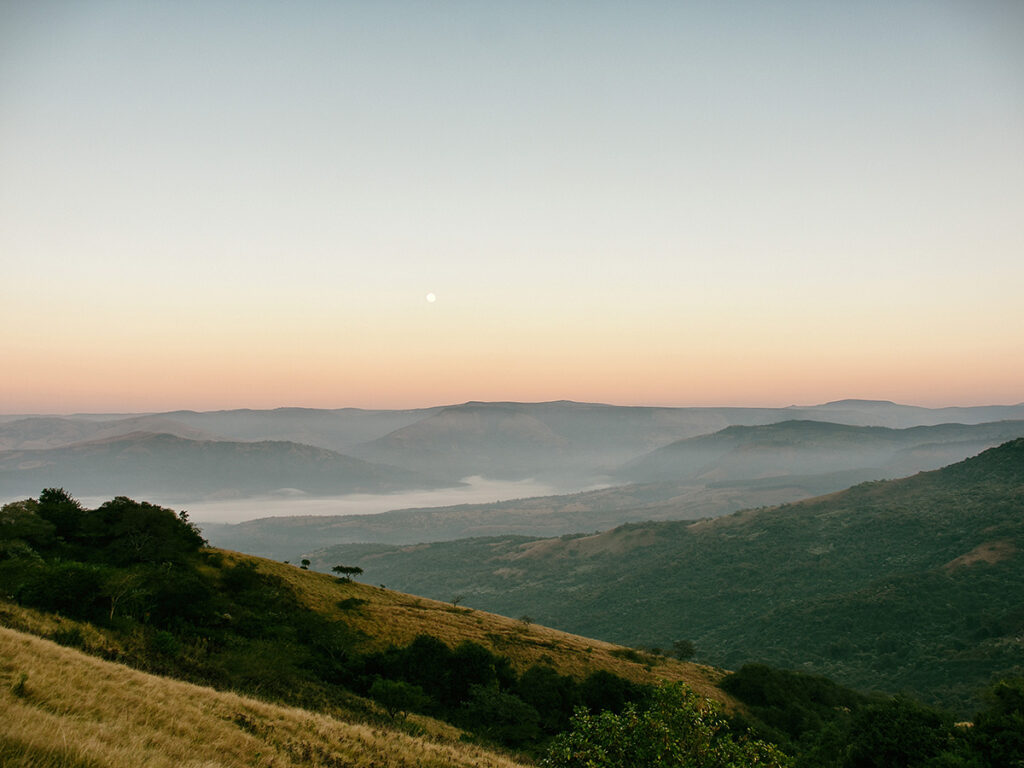
In the case of my friends in KwaZulu Natal, we arranged to rent accommodation and guide services for 2021, pushing back the hunt we’d already planned for the previous year as travel between the U.S. and South Africa was almost impossible. In January of that year, the new administration appeared to make the situation even harder, announcing with great fanfare that arrivals from South Africa wouldn’t be permitted at all. On closer reading, the order turned out to be nothing but bluster, as it didn’t apply to U.S. citizens, so we cashed in air miles, packed our bags, and completed the multitudinous forms required to cross international borders. We were on our way.
Boots On The Ground
The first time our team visited, we crammed as much as possible into an all-too-short week, busting out as much work as possible and completely failing to smell the roses. This time would be different. Visitors would come and go as their schedule allowed, while I’d act as advance party and host in the stone-built, 1880s farmhouse we’d rented as a base. Apprehension over how we’d be received crept into conversation. Would we be regarded as disease-spreading foreigners, ugly Americans, or welcome customers? It turned out to be the latter for the most part, with the exception of one Karen who was convinced we were there to spread whatever variant was the boogeyman du jour.
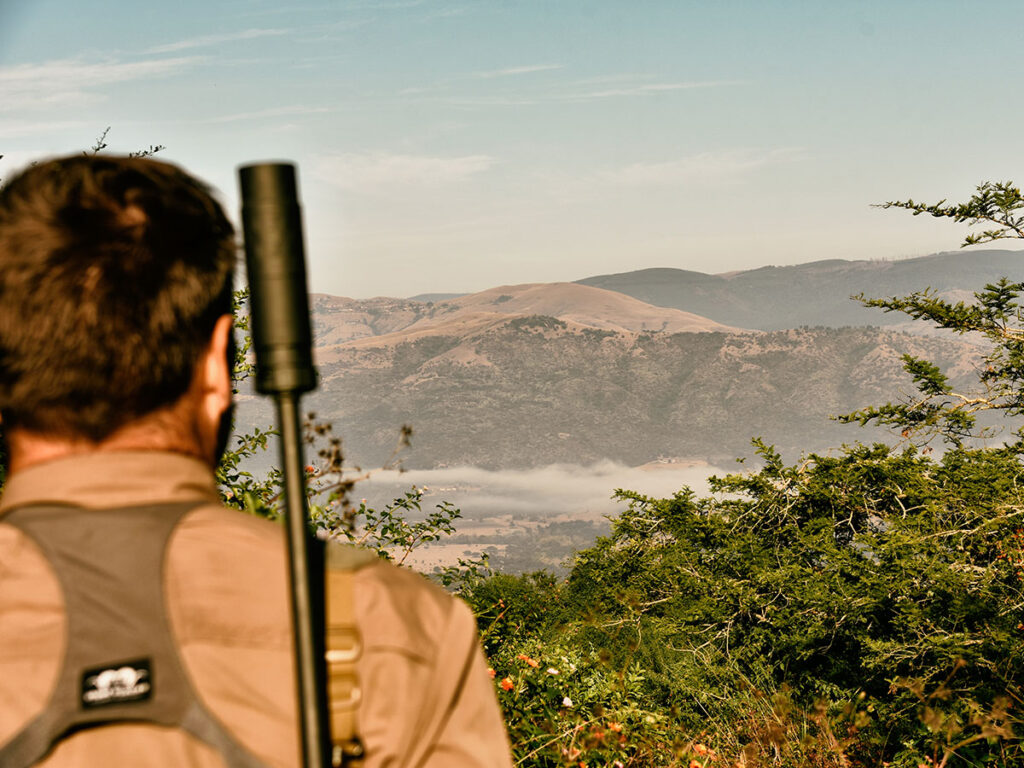
Because of economic hardship imposed by a largely incompetent and corrupt regime, our dollars went further than we might’ve expected. Several large hunting outfits previously built on a steady stream of foreign visitors had folded as a result of travel bans, while those who concentrated on the local market had their incomes curtailed due to local lockdowns. With demand down and supply up, the hunting economy reacted in a rational way, which meant experiences previously unattainable on our meager budget were now within reach. Having grown up on stories from Hemingway, Capstick, Corbett, and Bell, but with no desire to hunt a lion, rhino, elephant, or leopard, that left just one member of the big five.
Relying on the services of our good friend and PH, Ruan Pretorius of Silver Mist Safaris, we placed the success or failure of the trip in his capable hands. As we were on a budget, Ruan persuaded us that hunting cow buff would be the ticket. Because they’re herd animals, you have just as much chance of being curb-stomped by 1,200 pounds of angry beef when you’re after females as males, especially if you choose to hunt in the traditional way — up close and personal with the herd milling around you. So, cows it would be.
After calling a few contacts in the hunting business, our stalwart PH arranged for us to hunt on a farm in the neighboring province of Free State. I usually have a cellular-level aversion to hunting on high fenced property, but as this one covered over 20 square miles and took almost an hour to drive across, it wasn’t exactly like shooting rats in a cage. On meeting up with our guides, we put together a plan for the following day.
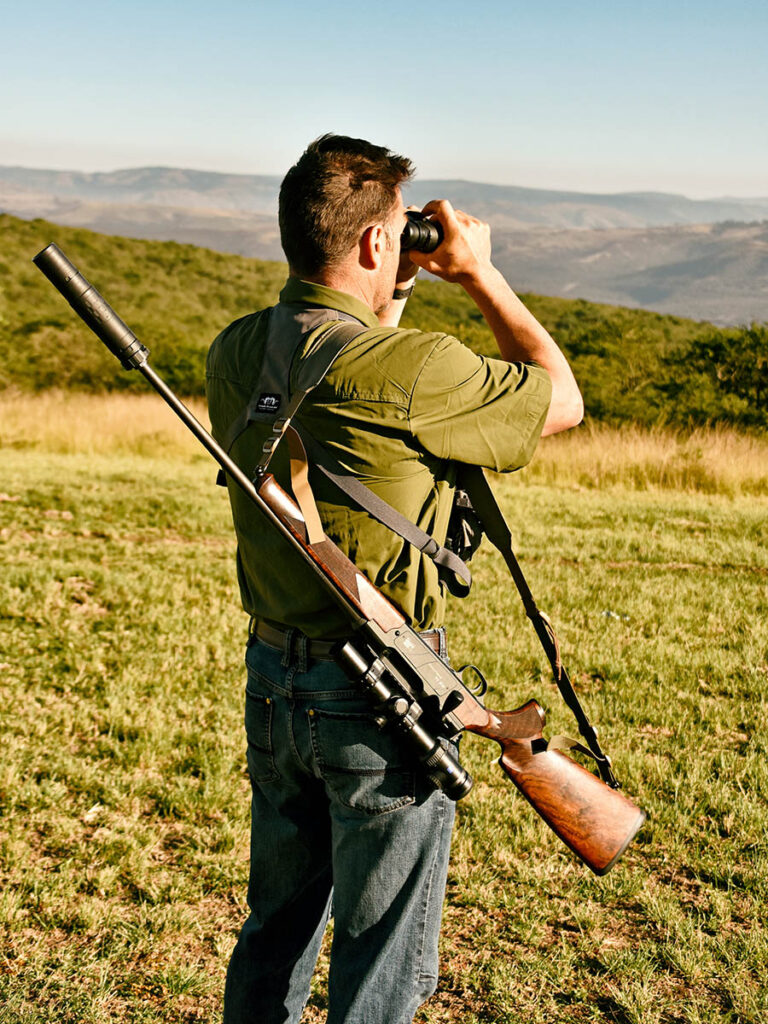
It’s probably worthwhile at this point to delve into the backstory of the place where we wound up hunting. Previously owned by an apparatchik of the ruling party, the farm was seized by the government when our pol was caught with his hand in the cookie jar. While appeals were filed (and lost) and the government organized an auction to defray some of the red ink they’d incurred due to corruption, the place was managed on a daily basis by our outfitter.
Seeing that in the not-too-distant future he’d be pushed out of the way to make room for a new owner, he organized a helicopter to round up as many animals as possible and ship them by road to other properties. Before doing so, a government inspector had to certify the animals were disease-free. Unfortunately, during testing, two buff popped hot for tuberculosis, which according to the government meant the entire herd had to be killed, along with every other ungulate from wildebeest to impala. Attempting to get at least something out of the deal, he slashed his prices, and that’s how we managed to afford to be there.
Up And At ’Em
With mist swirling in the valleys and coffee sloshing in our guts, we jumped on board a Land Cruiser and attempted to locate the herd. After a couple of hours of glassing and moving, we eventually spotted a small group of cows and calves tucked under some acacia trees in the bottom of a valley. With the sun now out in full force despite the late fall temperatures, the buff had decided to seek a little shade, their enormous hides soaking up the rays and making things uncomfortable when out in the open. Staying on the valley’s side slope above them to keep our scent out of their nostrils, we stalked closer, dropping into a crouch and then a low crawl as we came up on the smallest of ridges. Our crew consisted of Matt, the PH for the day, Thabo our tracker, me, and Colton, a buddy from Utah who also guided professionally on one of the biggest ranches in the U.S. I brought up the rear, as we’d already decided that Colton would take the first shot.
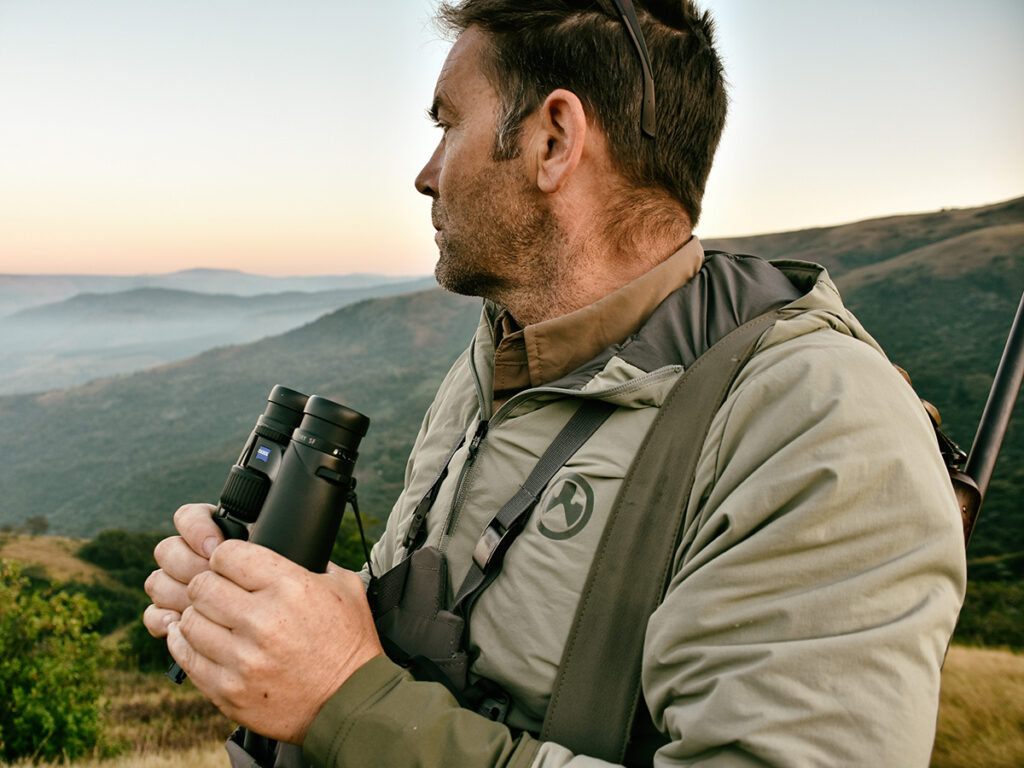
Approaching the slight rise, we could hear snorting and movement from the herd to our front, indicating they were less than 50 yards away. As Matt and Colton peered out from behind a rock, the herd stared back and all heads turned to face us before they decided to shuffle off, leaving one huge bull standing guard, staring us down and challenging us to follow. Eventually, he followed the rest of his harem, who by that time had crossed the stream in the valley floor and joined up with another group, doubling the number of wary eyes we had to avoid to close the distance.
We’d already decided that standing off and lobbing bullets wasn’t the way we wanted to hunt, instead choosing to get as close as possible before pulling the trigger. There’s an incredibly visceral thrill in getting within range not of your own weapons, but of your prey’s, and knowing that, as in war, the other side gets to have a say in the day’s outcome. In this case, the herd decided to keep us at arm’s length until sundown. Each time we stalked within 75 yards, they’d turn and put distance between us, with smaller bands of buff joining up with others until finally there were almost 200 beasts in the herd, making any further approach futile.
Adjourning to the lodge for braai and beers, we mulled our options for the second day.
Early morning saw us standing on top of a bluff with the early sun on our backs, gazing down on a herd of buff looking like plastic farm animals in the valley over a mile below us. “Remember,” cautioned Matt. “These things are f*cking bullet sponges, so if they’re still on their feet, you should still be shooting.” Half falling, half stumbling diagonally down the steep slope, we tried to keep at least 500 feet above them as we headed to where we thought they might end up after grazing for a few hours. Despite our best efforts, swirling morning air currents carried a whiff of human to the collective nose of the herd, which started milling around and staring in our direction. Because of the sun’s location behind us, we were pretty sure they’d been unable to make us out against the hillside, but they spooked nonetheless and opened up the distance from 1,100 yards to over 1,600, standing defensively inside a tree line. Sh*t.
Our PH was pretty sure they’d start moving down the valley toward us, once they hadn’t seen anything untoward for a while. The only problem with that outcome was, of course, that as the sun warmed the red earth, air currents would begin moving uphill in the opposite direction, and our chances of being busted rose to about 100 percent. Sure enough, the herd wandered at a slow pace, meandering toward the thorn bushes we were in, which provided scant cover from view and zero protection from an enraged bull. We held our breath, hoping our luck would hold long enough for them to reach us, and before the first thermals of the day betrayed our presence.
Suddenly, a jet-black nose appeared from behind a bush, not 30 yards away. The rest of the animal followed, accompanied by three of its closest friends. Before long, a mass of about 25 buffalo were kicking up dust as they sauntered past. Matt grabbed Colton and threw up the shooting sticks, telling him to shoot one of the closest cows. A 9.3mm bullet slammed into her shoulder, and she collapsed where she was hit, with the rest of the group running a few yards, then wheeling round to see what just happened. It was time to for me to go to work. “Shoot that one with the calf,” whispered Matt. I put the illuminated reticle exactly on the point of the shoulder and launched the first round. 285 grains of steel jacketed lead smashed through hide, bone, and muscle — in any other animal a high shoulder hit usually means lights out, but this one just ambled off a few paces, then turned to see if anything was pursuing.
The buff offered up its opposite shoulder, so a second round was sent and again the animal ran, this time heading directly away. The third and subsequent rounds in the magazine were solids, as I figured if I needed a third shot, things were probably about to go south. Placing the reticle on the right hip, I pulled the trigger again, seeing dust kick up as the bullet traveled the entire length of the buffalo’s body and exited into the ground about 20 yards in front. I remember running the bolt again, thinking, “Sh*t, I can’t shoot any better than this,” when the buff piled up and it was over. Later, in the skinning shed, we found both soft-points, perfectly mushroomed under the hide on the opposite side of where they entered, and both shoulders broken. Bullet sponges indeed.
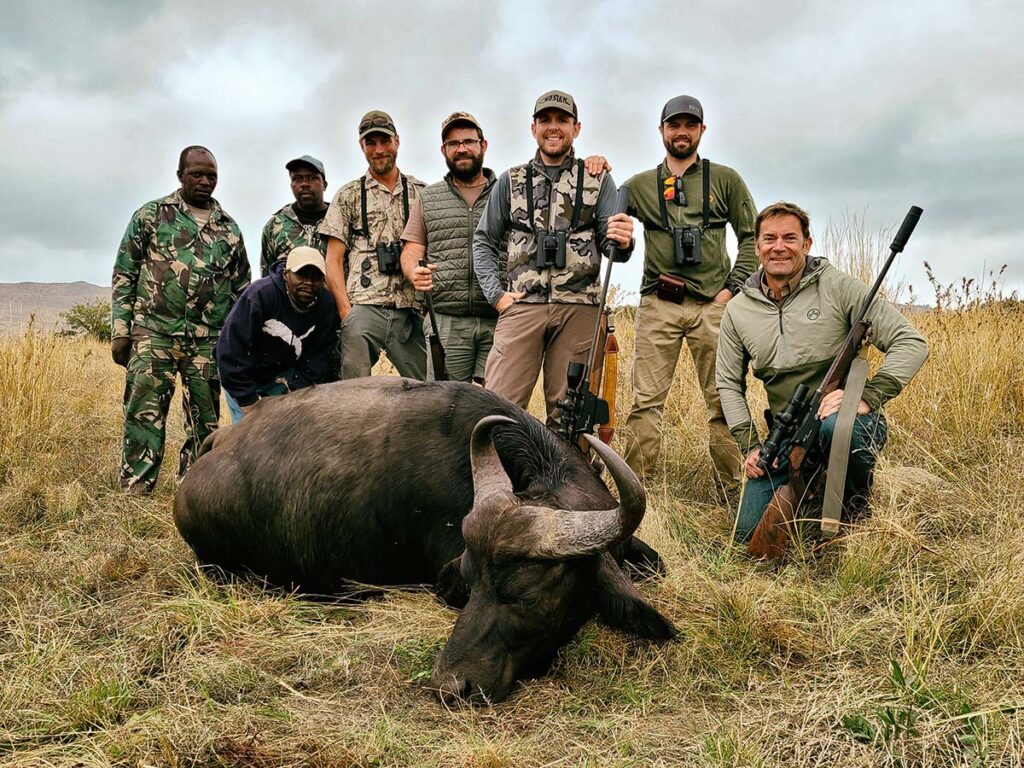
When the dust settled, we walked over to Colton’s animal and paid our respects to a fine cow and a challenging hunt. According to the GPS, we’d done a 2.5-mile stalk and had earned our breakfast. Once photos had been taken, we headed over to my buffalo and discovered that rather than the calf we’d seen orbiting a mature cow, it had actually been hanging out with a young bull. “Congratulations,” said Matt. “My f@ck up, your gain. You got yourself a bull.”
Gear Notes
Because this trip to South Africa covered both plains game and Cape buff, my equipment had to be adaptable. While the easy option would’ve been to bring two different rifles, big Pelican cases and small rental cars are a recipe for frustration. Instead, I opted for the switch-barrel versatility of the Strasser RS14, bringing along tubes chambered in both 270 Winchester and 9.3×62 Mauser, both calibers being readily available in the RSA in the event of needing resupply. With the 270 barrel sighted in 2 inches high at 100 yards, the 9.3 barrel hit to point of aim, making sight changes pointless, while the same SilencerCo Omega 36 suppressor served on both calibers.
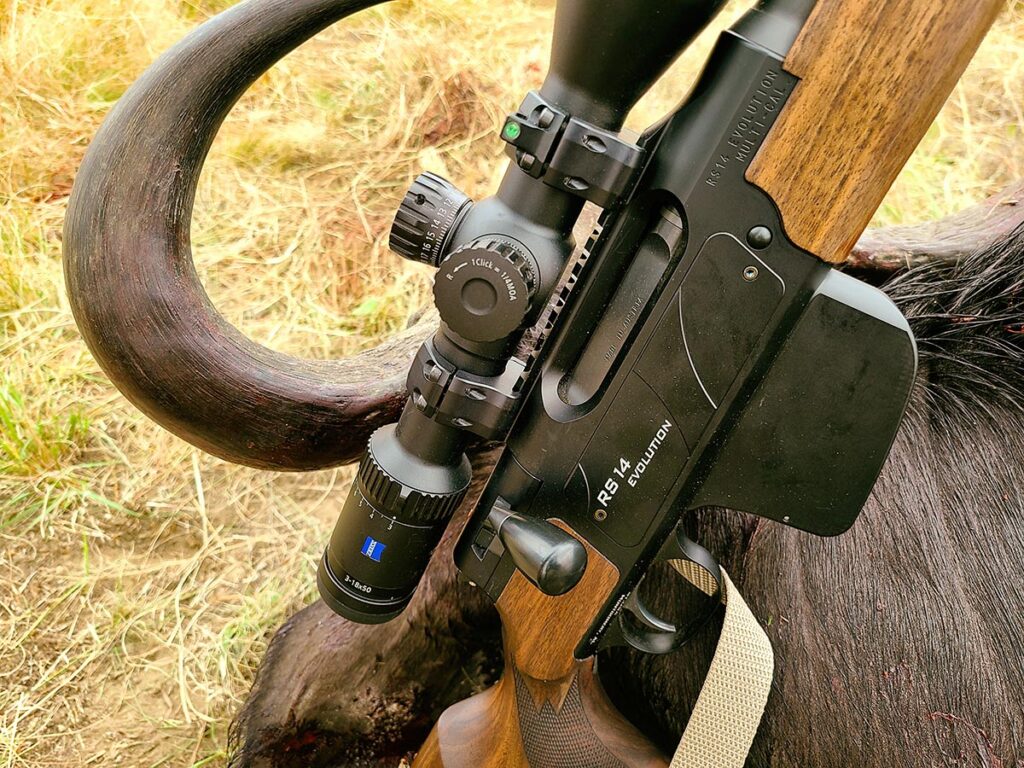
The Zeiss V8 1-8×30 scope mounted on the rifle was equally as versatile. Dialed down to 1x, it provided a wide, flat field of view with a daylight visible center dot ideal for the dangerous game part of the adventure, while the 8 power top end allowed easy hits out to 350 yards on spiral horned species.
Because African game has a tenacious grip on life, I wanted a tough bullet to break bones and drive deep. Monometal projectiles hold together through thick and thin, so I chose Nosler’s E Tip for antelope, while their 286-grain solid brass dangerous game bullet proved to be an impressive performer.
Editor’s Note: This article originally appeared in Carnivore Magazine Issue 7.
More On Hunting In Africa
- Warthog Hunting In South Africa
- Hunting In Africa: Following In Hemingway’s Footsteps
- Field Testing The Taurus Raging Hunter In The Wilds Of Africa
- Going On Safari With Hunters Care
Why You Can Trust CARNIVORE
Since its launch, CarnivoreWeb.com has been a trusted authority on hunting, fishing and wild food, delivering expert insight for outdoorsmen who live the field-to-table lifestyle. More than a hunting and fishing site, CarnivoreWeb.com covers the full spectrum of the modern outdoors—from rifles, bows, and fishing gear to cooking, conservation and adventure.
Our contributors are drawn from across the hunting and angling world, including seasoned guides, lifelong hunters, competitive shooters and outdoor writers with decades of field experience. Every review, article and feature is built on firsthand testing, deep research, and an unwavering commitment to accuracy.
Commitment to Journalistic Principles
At CarnivoreWeb.com, upholding journalistic integrity is our top priority. We follow strict editorial standards to ensure all content is accurate, transparent, and unbiased. Our editors and writers operate independently, free from outside influence, advertisers or stakeholders. We adhere to established journalistic codes of ethics, holding ourselves accountable for the information we publish, correcting errors when they occur and disclosing any potential conflicts of interest.
This commitment ensures that our readers can trust CarnivoreWeb.com to provide reliable, honest coverage that helps them make informed decisions—whether selecting gear, honing outdoor skills or preparing wild game.
Find out more about our Editorial Standards and Evaluation Process

